 Bastien
Bulk Fermentation
The primary rise of bread dough after mixing, where yeast or starter ferments the dough as a single mass before shaping.
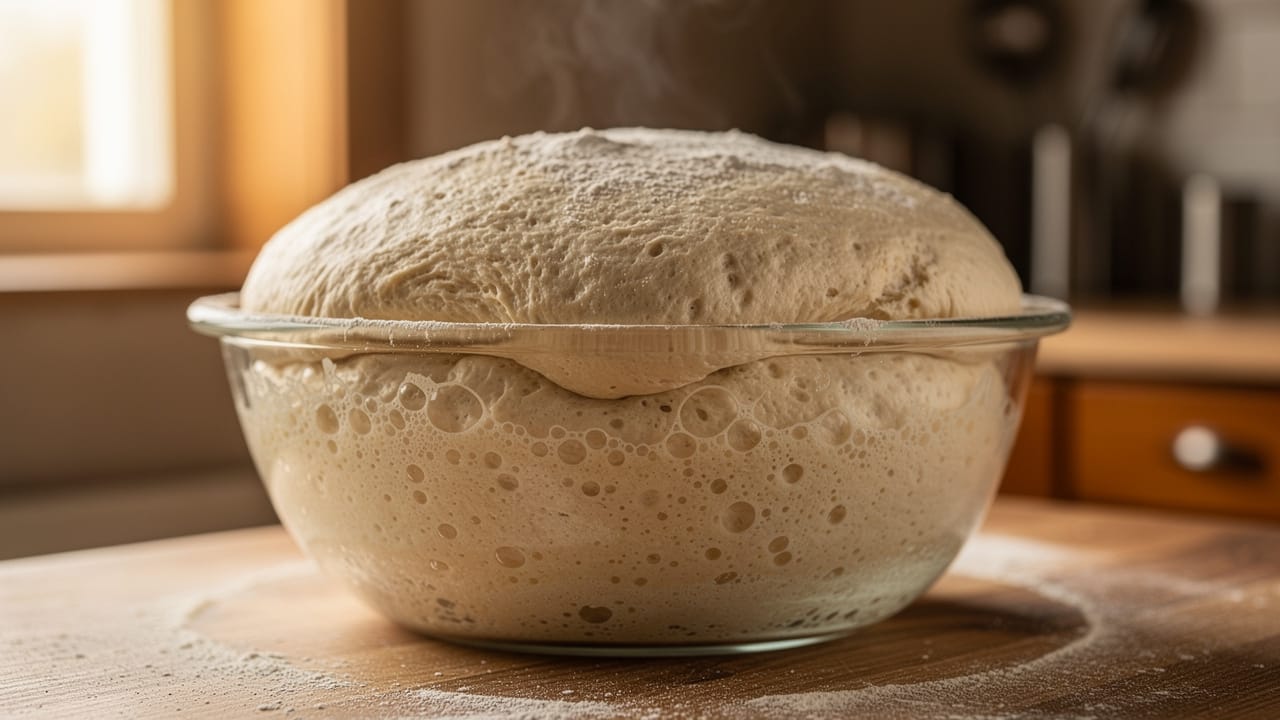
Bulk fermentation (also called the first rise, bulk proof, or pointage) is the stage after mixing where the entire batch of dough ferments together as one mass before being divided and shaped. It is the most important step in bread making — the stage where flavor, structure, and texture are built.
During bulk fermentation, three processes happen simultaneously: yeast produces gas (making the dough rise), bacteria and yeast create flavor compounds (organic acids, alcohols, esters), and the gluten network matures (giving the dough strength and elasticity). Getting bulk fermentation right means getting your bread right.
What happens during bulk fermentation
| Process | What it does | Why it matters |
|---|---|---|
| Gas production | Yeast converts sugars to CO2 and alcohol | Creates the air pockets that become the crumb |
| Acid production | Bacteria produce lactic and acetic acids | Develops flavor (mild tang in sourdough) and strengthens gluten |
| Gluten maturation | Protein bonds strengthen and organize | Dough holds its shape and traps gas effectively |
| Enzymatic activity | Amylase breaks starch into sugars | Feeds yeast and contributes to crust color |
| Flavor development | Organic acids, alcohols, and esters accumulate | Complex, wheaty, slightly sweet flavor |
The longer and slower the bulk fermentation, the more flavor develops. This is why cold fermentation and long bulk schedules produce better-tasting bread than quick-rise methods.
Bulk fermentation timing
Time depends on dough type, yeast/starter amount, and temperature:
| Dough type | Temperature | Typical duration | Volume increase |
|---|---|---|---|
| Commercial yeast, standard | 24-26°C (75-78°F) | 1-2 hours | 50-75% |
| Commercial yeast, low-yeast | 22-24°C (72-75°F) | 3-4 hours | 75-100% |
| Poolish/biga dough | 24-26°C (75-78°F) | 2-3 hours | 50-75% |
| Sourdough, room temp | 24-26°C (75-78°F) | 4-6 hours | 50-75% |
| Sourdough, cool room | 18-20°C (65-68°F) | 6-10 hours | 50-75% |
| Cold bulk (fridge) | 3-5°C (38-41°F) | 12-48 hours | 25-50% |
These are guidelines. The dough tells you when it is ready — not the clock. Temperature is the biggest variable: fermentation speed roughly doubles with every 5°C increase.
How to judge when bulk is done
Visual cues
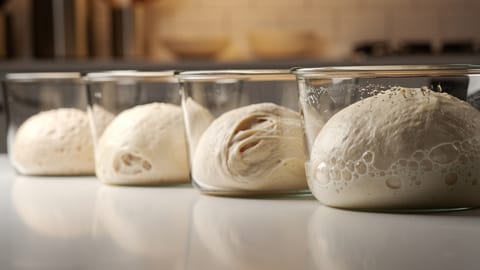
- Volume increase: the dough has expanded 50-100% from its starting size. Mark the starting level on your container to track this.
- Domed surface: the top is gently domed and smooth, not flat or collapsed
- Bubbles: small to medium bubbles visible on the surface and sides of the container
- Jiggle: the dough wobbles like jelly when you gently shake the container
- Edges pulling away: the dough may begin to release from the sides of the container
The poke test
Press a floured finger about 1 cm into the dough:
- Springs back quickly → under-fermented, needs more time
- Springs back slowly, leaving a slight indent → ready
- Does not spring back, indent stays → over-fermented
Under vs over fermentation
| Under-fermented | Properly fermented | Over-fermented | |
|---|---|---|---|
| Volume | Less than 50% increase | 50-100% increase | May have risen and fallen back |
| Surface | Tight, few bubbles | Domed, bubbly | Flat or concave, very bubbly |
| Feel | Dense, stiff | Light, airy, jiggly | Slack, sticky, no structure |
| Poke test | Springs back fast | Springs back slowly | Does not spring back |
| Result | Dense, tight crumb | Open, even crumb | Flat loaf, gummy crumb |
Over-fermented dough has exhausted its food supply. The gluten has degraded, so the dough cannot hold gas. There is no fix — you need to start over or accept a denser loaf.
Stretch and fold during bulk
Instead of heavy kneading, many bakers build gluten strength through stretch and folds performed during bulk fermentation. This technique is central to high-hydration and sourdough baking.
How to stretch and fold
- Wet your hands to prevent sticking
- Grab one side of the dough, stretch it upward until you feel resistance
- Fold it over the top to the opposite side
- Rotate the container 90° and repeat
- Complete 4 folds (one from each side) — this is one set
Stretch and fold schedule
| Dough type | Number of sets | Interval | During which phase |
|---|---|---|---|
| Standard yeasted | 2-3 sets | Every 30 min | First 1-1.5 hours |
| High-hydration | 3-4 sets | Every 30 min | First 2 hours |
| Sourdough | 3-6 sets | Every 30-45 min | First 2-3 hours |
After the last set of folds, leave the dough undisturbed for the remainder of bulk. This rest period is when the dough does most of its rising — the folds build structure, the rest builds volume.
What stretch and folds accomplish
- Build gluten without the oxidation that mechanical mixing causes
- Equalize temperature throughout the dough
- Redistribute food for yeast (sugars move to where yeast needs them)
- Incorporate air for a more open crumb
- Degas partially to keep fermentation active
Temperature control
Temperature is the single most important variable in bulk fermentation. Small changes have large effects:
| Temperature | Fermentation speed | Flavor profile |
|---|---|---|
| 18-20°C (65-68°F) | Slow (6-10 hours) | More complex, mild acidity, wheaty |
| 22-24°C (72-75°F) | Moderate (4-6 hours) | Balanced flavor and acidity |
| 24-26°C (75-78°F) | Standard (3-5 hours) | Good flavor, efficient timing |
| 28-30°C (82-86°F) | Fast (2-3 hours) | Less complexity, can become too acidic |
| 3-5°C (38-41°F) | Very slow (12-48 hours) | Maximum flavor development |
Managing temperature
Desired dough temperature (DDT) is how professional bakers control bulk timing. For most bread, target 24-26°C (75-78°F). Calculate it by adjusting your water temperature:
Water temp = DDT × 3 − flour temp − room temp − friction factor
For home baking without a friction factor, simplify: if your flour and room are both 22°C and you want 25°C dough, use 31°C water.
Use a clear container and an ambient thermometer to monitor. If your kitchen is cold, place the dough near (not on) the oven, or in the oven with just the light on. If your kitchen is hot, use colder water or start with a brief fridge rest.
Bulk fermentation for pizza dough
Pizza dough typically uses a shorter room-temperature bulk (1-2 hours) followed by cold fermentation after dividing into dough balls. The bulk phase develops initial gluten structure, while the cold proof develops flavor.
Some pizza styles skip extended bulk entirely — Neapolitan dough often goes straight from mixing to balling to cold proof. Roman-style and high-hydration pizza doughs benefit more from a longer bulk with folds. The pizza dough calculator generates a complete fermentation schedule for each style, including bulk and ball proof times.
Bulk fermentation for sourdough
Sourdough bulk takes longer because wild yeast ferments more slowly than commercial yeast. The trade-off is more flavor. Key differences:
- Starter strength matters: a well-fed, active starter at peak produces faster, more predictable bulk
- Temperature sensitivity is higher: sourdough fermentation slows more dramatically in cold conditions
- Timing varies more: same recipe can take 4 hours one day and 7 the next, depending on starter health and ambient temperature
- Over-fermentation risk is higher: sourdough dough degrades more noticeably when bulk goes too long
Judge sourdough bulk by the dough, not the clock. Volume increase (50-75%) and the jiggle test are more reliable than time.
Containers for bulk fermentation
Use a clear, straight-sided container so you can see and measure the rise:
| Container | Pros | Cons |
|---|---|---|
| Cambro / clear plastic tub | See-through, straight sides for measuring, easy to fold in | Can scratch over time |
| Glass bowl | See-through, non-reactive | Curved sides make volume harder to judge |
| Round plastic dough bucket with lid | Marks for volume, good seal | Not always transparent |
| Stainless bowl with plastic wrap | Readily available | Cannot see sides, wrap can stick |
Mark the starting dough level with a rubber band or tape on the outside. This makes tracking percentage rise straightforward.
Troubleshooting
| Problem | Likely cause | Fix |
|---|---|---|
| Dough not rising | Kitchen too cold, weak yeast/starter, or too much salt | Move to warmer spot, check yeast freshness, verify salt amount with scale |
| Rising too fast | Kitchen too warm or too much yeast | Use colder water, reduce yeast, or move to cooler spot |
| Dough spreading flat | Over-fermented or too high hydration without enough folds | Shorten bulk time, add more fold sets, or reduce hydration |
| Dense after baking | Under-fermented | Extend bulk time; wait for 50-75% volume increase |
| Sticky and slack after bulk | Over-fermented gluten breakdown | Cannot be fixed; next time shorten bulk or lower temperature |
| Uneven crumb | Insufficient folds during bulk | Add 1-2 more stretch and fold sets |
Tips for better bulk fermentation
Use a clear container. Tracking volume increase is the most reliable way to judge fermentation progress. Curved bowls make this harder — straight-sided containers are better.
Control temperature first. Before adjusting yeast or timing, get your dough temperature right. A thermometer and calculated water temperature solve most timing inconsistencies.
Do not rush. Longer, slower bulk fermentation always produces better-flavored bread. If you are short on time, use cold fermentation overnight rather than adding more yeast.
Mark your starting level. A rubber band or piece of tape on the container at the dough's starting height makes it easy to see 50%, 75%, or 100% rise.
Use baker's percentages. Knowing your exact yeast percentage helps you predict bulk timing and adjust between bakes.
Bulk fermentation in Fond
Fond's Bread Studio tracks bulk fermentation with a built-in timer and visual progress indicator. When you start a bread recipe, the app monitors dough temperature, suggests fold timing, and alerts you when bulk fermentation is approaching completion based on your dough type and kitchen temperature. All timing is adjusted automatically when you use recipe scaling to change batch size.
Frequently asked questions
Can I do bulk fermentation in the fridge?
Yes. Cold bulk fermentation slows yeast activity dramatically, extending the rise to 12-48 hours. The result is more flavor development and a more convenient schedule — mix in the evening, shape the next morning. The dough will rise less in the fridge (25-50%) compared to room temperature.
How many stretch and folds do I need?
It depends on your dough. Low-hydration doughs (60-65%) may need only 2 sets. High-hydration doughs (75%+) benefit from 4-6 sets. Stop when the dough holds its shape well and feels smooth and strong after folding.
What if I forget about my dough and it over-ferments?
If the dough has collapsed and smells strongly of alcohol, it is over-fermented. You can still bake it, but expect a denser, flatter loaf with a more sour flavor. For next time, set a timer or use cold fermentation for a wider time window.
Is bulk fermentation the same as proofing?
No. Bulk fermentation is the first rise of the whole dough mass. Proofing (also called final proof) is the second rise after shaping into individual loaves or dough balls. Both involve fermentation, but they serve different purposes — bulk builds flavor and structure, proofing builds volume in the shaped dough.
Cook smarter
Join the waitlist for Fond. Recipes, meal plans, and a little AI sous-chef that learns how you cook.
Related terms
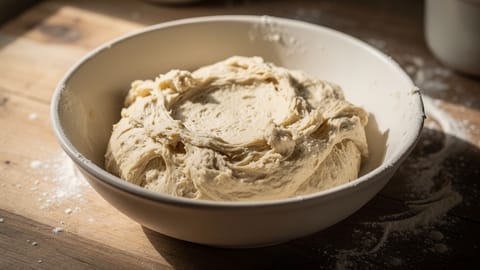
Autolyse
A bread-making technique where flour and water are mixed and rested before adding salt and leavening, allowing gluten to develop naturally.
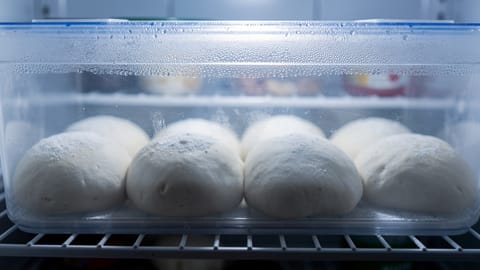
Cold Fermentation
A technique of retarding dough in the refrigerator (2-5°C) for 24-72 hours, slowing yeast activity while allowing enzymes to develop deeper flavors and better texture.

Fermentation
A metabolic process where microorganisms convert sugars into acids, gases, or alcohol — the basis of bread, yogurt, kimchi, and beer.

Folding
A gentle mixing technique that preserves air in delicate batters by cutting through and turning the mixture rather than stirring.

Gluten Development
The process of building a protein network in dough through kneading, folding, or time, creating the structure that gives bread its chew and allows it to rise.
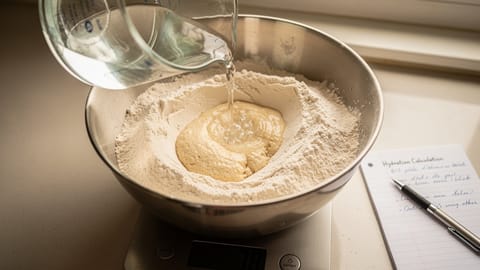
Hydration (Bread)
The ratio of water to flour in bread dough, expressed as a percentage. Higher hydration means wetter, more open-crumb bread.
Pizza Dough Fermentation: Room Temperature vs Cold Fermentation
Room temp vs. fridge, 4 hours vs. 72 hours, and how to tell when your dough is actually ready. The time-temperature relationship is the single biggest lever for better-tasting pizza.