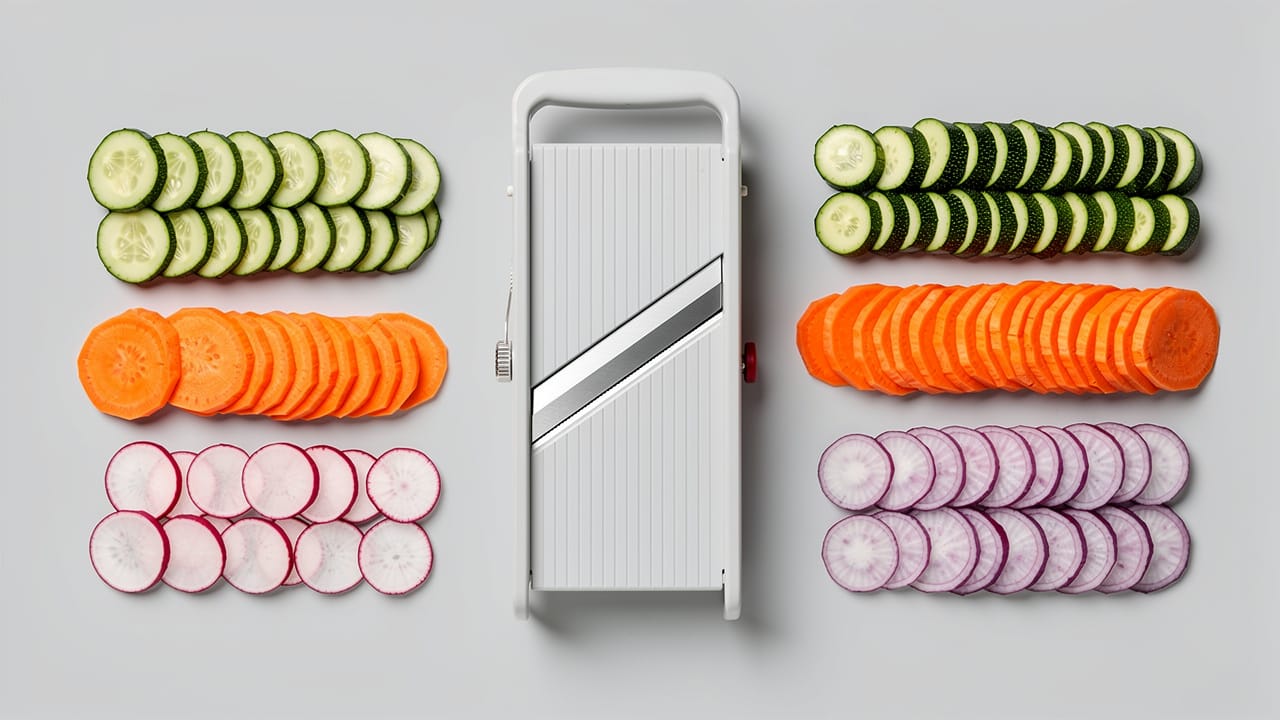
 Bastien
Mandoline
A precision slicing tool with an adjustable blade that creates uniform thin cuts for vegetables, fruits, and more.
A mandoline is a slicing tool with an adjustable blade that produces consistently thin, uniform cuts nearly impossible to achieve by hand. It is the tool behind paper-thin potato chips, perfect gratins, and the kind of vegetable presentation you see in restaurant kitchens.
Uniform thickness is not just about looks — it is about even cooking. When every slice is the same width, they all cook at the same rate, whether you are blanching vegetables, frying chips, or layering a gratin. A mandoline delivers that consistency in seconds.
Why use a mandoline
| Advantage | Details |
|---|---|
| Uniform thickness | Every slice identical — critical for even cooking and professional presentation |
| Speed | Slice an entire potato in under 10 seconds |
| Thin cuts | 1mm or thinner — impossible to achieve reliably with a knife |
| Consistency | No skill variance — a beginner gets the same result as a chef |
| Versatility | Straight slices, julienne, waffle cuts, and batonnets from one tool |
A sharp knife in skilled hands can produce beautiful slices, but it cannot match a mandoline for speed, thinness, or batch-to-batch uniformity. For recipes where consistent thickness matters — chips, gratins, pickles, carpaccio — a mandoline is the right tool.
Types of mandolines
| Type | Construction | Thickness range | Blade types | Best for | Price range |
|---|---|---|---|---|---|
| French (de Bron style) | Stainless steel frame, folding legs | 1–10mm+ | Straight, julienne, waffle | Serious home cooks, professional kitchens | $80–200+ |
| Japanese (Benriner style) | Lightweight plastic body, steel blade | 0.5–8mm | Straight, julienne (interchangeable) | Everyday use, best value | $25–50 |
| Compact handheld | Molded plastic, single blade | Fixed or 2–3 settings | Straight only | Beginners, small kitchens, occasional use | $10–25 |
| Adjustable dial | Stainless or plastic, rotating dial | 0.5–9mm | Straight, some with julienne | Cooks who want quick thickness changes | $30–80 |
The Japanese-style mandoline (like the Benriner) is the most popular choice for home cooks — affordable, razor-sharp, lightweight, and effective. French mandolines are more robust and offer more cut types, but most home cooks do not need the extra features.
Common cuts and applications
| Cut | Thickness | How | Best applications |
|---|---|---|---|
| Straight slice | 1–3mm | Standard blade, food flat against platform | Chips, gratins, scalloped potatoes, pickles, carpaccio |
| Paper-thin | 0.5–1mm | Thinnest setting, steady pressure | Radish garnishes, fennel salad, fruit tarts |
| Julienne | 2–3mm matchsticks | Julienne blade attachment | Salads, stir-fries, garnishes, coleslaw |
| Waffle (gaufrette) | 2–3mm | Waffle blade, rotate food 90° between slices | Decorative chips, lattice fries, better sauce adhesion |
| Batonnet | 6–8mm sticks | Thick setting + julienne blade | Fries, crudités, vegetable sticks |
| Crinkle cut | Variable | Crinkle blade (some models) | Crinkle-cut chips, visual interest |
The waffle cut deserves special mention — you rotate the vegetable 90° between each pass over the blade, creating a lattice pattern that fries into a crispy, open-textured chip. It takes practice but produces impressive results.
Best foods for a mandoline
Vegetables
- Potatoes — chips, gratins, scalloped potatoes, hasselback prep. The mandoline's signature use.
- Cucumbers — quick pickles, salads, sandwich slices. Uniform rounds in seconds.
- Onions — thin rings for frying, paper-thin slices for raw salads, French onion soup.
- Fennel — shaved paper-thin for raw salads. Fennel is difficult to cut this thin by knife.
- Cabbage — fine shred for coleslaw, sauerkraut, kimchi. Faster and more uniform than knife-cutting.
- Radishes — transparent-thin rounds for garnishes and salads.
- Zucchini and eggplant — uniform slices for layered dishes like ratatouille.
- Beets — thin slices for roasting into chips or raw carpaccio. Wear gloves — beet juice stains.
- Carrots — julienne for slaws and stir-fries, or thin rounds for quick-cook soups.
Fruits
- Apples and pears — paper-thin slices for tarts, salads, and dehydrating into fruit chips.
- Citrus — thin rounds for garnishing drinks, desserts, or candying.
- Strawberries — uniform slices for topping cakes and tarts.
What to avoid
Do not mandoline anything too hard (raw butternut squash, turnips), too soft (ripe tomatoes, avocado), or too small to hold safely. If the food does not sit flat and stable, cut a flat base with a knife first.
Essential safety rules
A mandoline is one of the most dangerous tools in a kitchen. The blade is exposed, razor-sharp, and positioned exactly where your fingers naturally go. Professional chefs treat mandolines with the same respect as commercial slicers.
- Always use the hand guard — the plastic guard that comes with every mandoline exists for a reason. Use it every single time, even for "just a few slices."
- Wear a cut-resistant glove — a Kevlar or stainless mesh glove on your food-holding hand is the best $10–15 insurance you can buy. Many professional kitchens require them.
- Keep the blade sharp — a dull mandoline blade is more dangerous than a sharp one. Dull blades require more pressure, which leads to slips.
- Stay focused — most mandoline injuries happen at the end, when the food gets small and you rush to get the last slice. Stop early.
- Stop before the end — when the food is too small to hold safely, stop. Use the remaining piece as a snack or toss it into your stock bag.
- Never reach over the blade — even when cleaning. Always handle a mandoline from the sides or back.
- Set up your workspace — have your mise en place ready: a stable cutting board underneath, a bowl to catch slices, and a damp towel to keep the mandoline from sliding.
Mandoline technique
Getting the best results
- Steady, even pressure — do not push hard. Let the blade do the work. Firm, consistent downward passes produce the most uniform slices.
- One smooth stroke — slide the food down the blade in a single fluid motion. Hesitating mid-stroke creates uneven slices.
- Cut a flat base — round vegetables (potatoes, beets) roll on the blade. Cut a thin slice off one side with a knife to create a flat surface before mandolining.
- Dry the food — wet vegetables slip on the blade. Pat dry with a towel, especially cucumbers and zucchini.
- Adjust for each food — harder vegetables (potatoes, carrots) slice easily. Softer items (zucchini, eggplant) need slightly thicker settings to avoid tearing.
After slicing
For foods like potatoes (chips or gratins), rinse slices in cold water to remove surface starch — this prevents sticking and produces crispier results. For salads and raw presentations, season slices immediately with salt and acid (lemon, vinegar) to draw out water and add flavor.
Mandoline care and maintenance
- Hand wash only — never put a mandoline in the dishwasher. The blade will dull, and the machine can damage plastic components.
- Dry immediately — steel blades rust if left wet. Wipe dry right after washing.
- Store with the blade guard — protect the blade and protect yourself. If your mandoline came with a blade cover, always use it.
- Sharpen or replace blades — Japanese mandolines often have replaceable blades. French mandolines can be sharpened with a fine whetstone. A dull mandoline is both dangerous and frustrating.
- Keep it accessible — like a kitchen scale, a mandoline you have to dig out of a drawer gets used less. Store it where you can grab it quickly.
Mandoline in Fond
When a Fond recipe calls for uniformly thin slices — gratins, chips, salads, or garnishes — the mandoline is the tool of choice. Fond's recipe instructions specify thickness when a mandoline is recommended, so you can set your blade to the right width before you start.
Frequently asked questions
Is a mandoline worth buying for home cooking?
Yes, if you regularly make any dish that requires uniform thin slices: gratins, chips, pickles, salads, stir-fries, or fruit tarts. The speed and consistency are significant. A good Japanese mandoline costs $25–35 and lasts for years.
What is the difference between a mandoline and a food processor slicing disc?
A mandoline gives you more control over thickness, produces thinner slices, and handles delicate items better. A food processor disc is faster for large batches but limited in thickness range and cannot do paper-thin cuts. For precision work, the mandoline wins.
How thin can a mandoline slice?
High-quality mandolines can slice as thin as 0.5mm — essentially transparent. This is useful for radish garnishes, fennel salads, and fruit chip preparation. Most recipes call for 1–3mm slices, well within any mandoline's range.
Do professional chefs use mandolines?
Frequently. Mandolines are standard equipment in professional kitchens for vegetable prep, garnish work, and any task requiring fast, uniform slicing. The French mandoline (de Bron) and Japanese Benriner are the most common professional choices.
Cook smarter
Join the waitlist for Fond. Recipes, meal plans, and a little AI sous-chef that learns how you cook.
Related terms
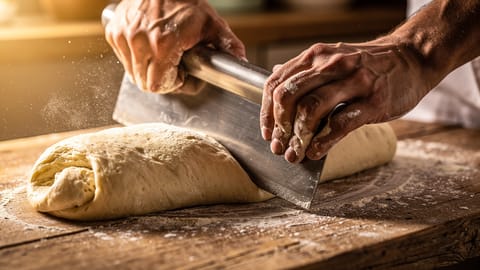
Bench Scraper
A flat metal or plastic blade used to cut, portion, and handle dough — and to keep your work surface clean.
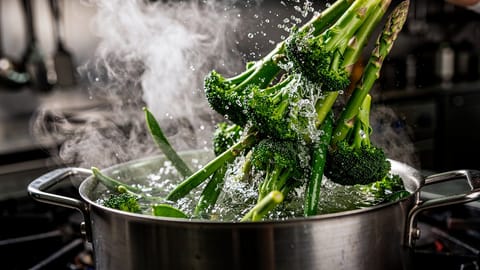
Blanching
Briefly boiling food then plunging it into ice water to stop cooking — used to preserve color, texture, and nutrients.
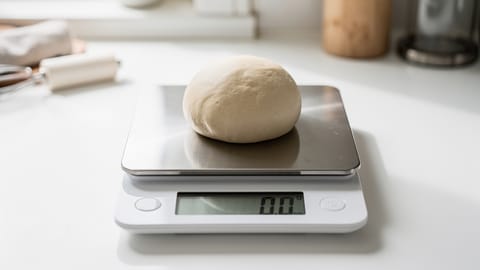
Kitchen Scale
A digital scale for measuring ingredients by weight — far more accurate than cups and spoons, especially in baking.
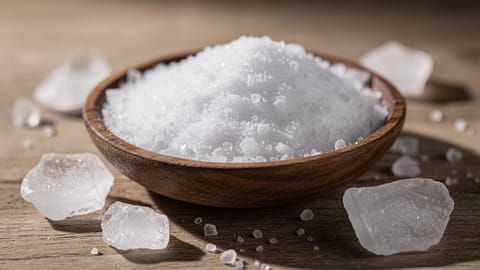
Kosher Salt
A coarse-grained salt with large, flat crystals that's preferred by chefs for seasoning because it's easy to pinch, dissolves well, and has no additives.
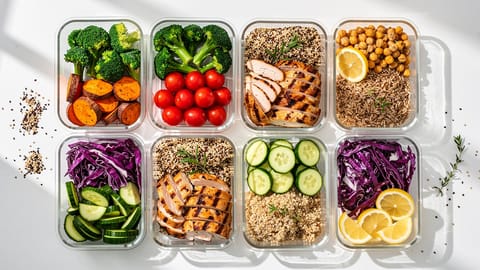
Meal Prep
Preparing meals or meal components in advance, typically for the week ahead, to save time and reduce daily cooking effort.
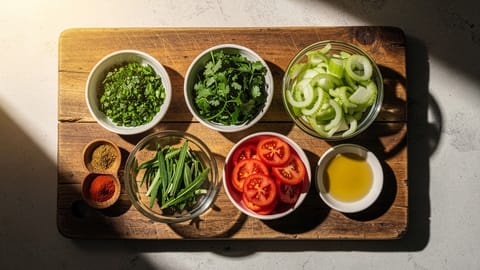
Mise en Place
The practice of preparing and organizing all ingredients before cooking — everything in its place.