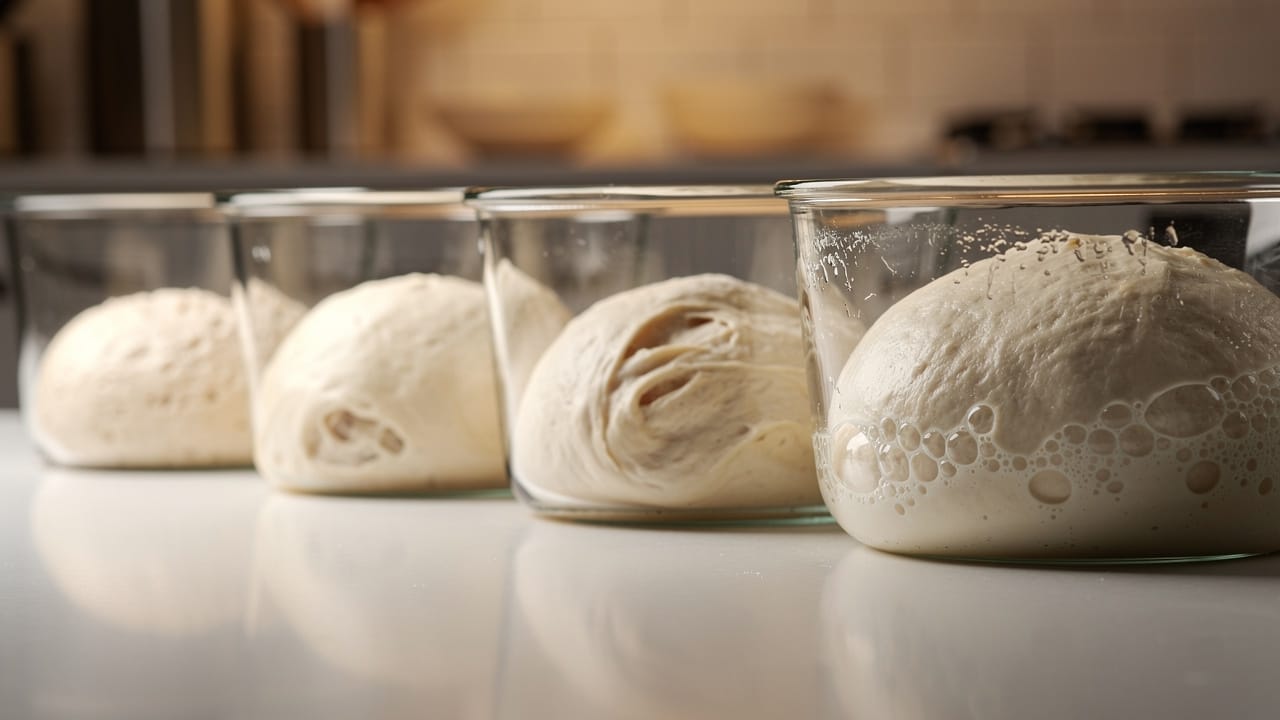
 Bastien
Pizza Dough Fermentation: Room Temperature vs Cold Fermentation
Room temp vs. fridge, 4 hours vs. 72 hours, and how to tell when your dough is actually ready. The time-temperature relationship is the single biggest lever for better-tasting pizza.
TL;DR: Pizza dough fermentation is the single biggest lever for better pizza. It deepens flavor, improves texture, and makes dough far easier to digest. Use the time-temperature relationship to your advantage: room temperature (68-78°F) for same-day dough in 4-8 hours, or cold fermentation (38-42°F) for 48-72 hours to develop complex, nutty flavors and a silkier crust. Learn to read your dough by sight and touch rather than relying on the clock alone.
What is pizza dough fermentation?
Pizza dough fermentation is the biological process where yeast consumes sugars in the flour and produces carbon dioxide, alcohol, and various flavor compounds. It is the single most important factor in your pizza's final taste, texture, and digestibility.
During pizza dough fermentation, several things happen at once: gluten develops and becomes more extensible, flavor builds up, the dough's structure strengthens, and enzymes break down complex starches into simpler, more digestible forms.
Pizza dough fermentation gives you control over flavor and texture. Whether you're making pizza in a few hours or planning days ahead, time and temperature are your two main levers.
Proofing vs fermentation: what's the difference?
These terms get used interchangeably, but they mean different things. Fermentation is the entire biological process — yeast eating sugars and producing CO2, alcohol, and organic acids. It starts the moment yeast meets water and flour, and continues until the dough is baked.
Proofing (also called the "final proof" or "apprêt") specifically means the last rise after you've shaped your dough balls. Bulk fermentation is the first rise before dividing.
In practice: all proofing is fermentation, but not all fermentation is proofing. When someone says "I ferment my dough for 48 hours," they usually mean the total time from mixing to baking, including both bulk and ball stages.
Why slow pizza dough fermentation matters
Here is the single most important thing I can tell you about pizza dough fermentation: slow is the secret. Slow fermentation improves digestibility because yeast pre-digests complex sugars during the long hours of fermentation. This is why properly fermented pizza does not leave you feeling bloated. The yeast has already done the heavy lifting before the dough ever hits the oven.
Fast-rise yeast defeats the entire purpose of craft pizza. If you want something quick, make flatbread. If you want real pizza, give it time.
The difference between a 4-hour dough and a 48-hour dough is not subtle. It is night and day in flavor, texture, and how your body handles it afterward. Once you experience a properly slow-fermented crust, there is no going back.
Choosing the right yeast for pizza dough fermentation
Not all yeast is created equal, and your choice matters more than you think for pizza dough fermentation.
Avoid fast-rise (instant rapid-rise) yeast for pizza. It works too quickly, skips the flavor-building stage, and leaves behind an overly yeasty taste that masks the natural wheat character of good flour. Fast-rise yeast is designed for convenience bread, not craft pizza.
Instead, reach for one of these:
- Active dry yeast: The reliable workhorse. Dissolve it in warm water (100-110°F / 38-43°C) before adding to your dough. It gives you excellent control over fermentation timing.
- Fresh compressed yeast (cake yeast): The professional's choice. More perishable but produces a cleaner flavor and more consistent fermentation. Use roughly 2-3x the amount compared to active dry.
- Instant dry yeast (not rapid-rise): Fine for cold fermentation since the fridge slows it down enough. Can be mixed directly into flour without pre-dissolving.
The goal is control. You want yeast that lets you dictate the pace, not the other way around.
Control factors for pizza dough fermentation
Understanding the levers you can pull gives you precise control over pizza dough fermentation timing:
- Moisture: Always keep your dough in a covered, lightly oiled container. Exposed dough forms a skin that blocks even fermentation and creates dry spots.
- Warmth: Room temperature (70-78°F / 21-26°C) drives active fermentation. The fridge (38-42°F / 3-6°C) slows everything down for flavor development. You control the pace by choosing where your dough sits.
- Sugar: Feeds the yeast. A small amount of sugar or honey (1-2% of flour weight) can kickstart fermentation, but too much creates an overly sweet crust and speeds things up unpredictably.
- Water: Using ice-cold water when mixing calms yeast activity from the start, giving you a wider window before fermentation takes off. Especially useful when you plan to ball the dough immediately and refrigerate.
- Salt: Slows fermentation and tightens gluten. This is why salt is always added after initial mixing. You want the yeast to get a head start before the salt reins it in.
- Diastatic malt: Provides enzymes that convert starches to sugars, giving the yeast more to feed on and promoting better browning via the Maillard reaction.
Get comfortable with these levers and you can ferment dough on your schedule, not the yeast's.
Tip: If your kitchen runs warm in summer, use ice water and reduce yeast by 20-30% to compensate. In winter, a slightly warmer proof spot (like the top of your fridge) can keep fermentation on track without overshooting.
The mixing order for fermenting pizza dough
The order you combine ingredients is not arbitrary. Each step has a purpose for proper pizza dough fermentation:
- Flour + diastatic malt powder (if using): Combine dry ingredients first so the malt distributes evenly
- Ice water: Hydrate the flour. Cold water slows yeast activity, buying you time for handling
- Yeast dissolved in warm water: Add your active dry yeast bloom (or crumble fresh yeast directly). The warm water activates the yeast while the already-cold dough tempers the overall temperature
- Starter (if using a preferment like poolish or biga): Incorporate it now while the dough is still shaggy
- Salt: Add after 5-10 minutes of mixing. Adding it too early inhibits yeast activity and tightens gluten before it has had a chance to hydrate properly
- Oil: Always last. Oil coats flour particles and interferes with hydration, so adding it after the dough has come together means full water absorption and proper gluten formation
This sequence lets the yeast get established, the gluten develop without interference, and the oil add tenderness without compromising structure.
Room temperature vs cold fermentation
Room temperature fermentation details
Room temperature pizza dough fermentation, also called bulk fermentation or same-day fermentation, means letting your dough rise at 68-78°F (20-26°C). It is faster and more straightforward, making it ideal for same-day pizza.
Typical timeline:
- Hour 0: Mix dough, initial development
- Hour 1-3: Bulk fermentation, dough doubles in size
- Hour 3-4: Divide and shape into balls
- Hour 4-8: Final proof, dough ready to stretch
- Result: Mild flavor, good rise, soft texture
Best practices:
- Use less yeast (0.5-1% of flour weight) for longer fermentation
- Maintain consistent temperature in the 70-75°F range
- Cover dough to prevent drying
- Watch for volume doubling, not just time elapsed
- Use within 8 hours for best results
Cold fermentation details
Cold pizza dough fermentation means refrigerating your dough at 38-42°F (3-6°C) for an extended period, typically 24-72 hours or longer. It produces better flavor, better texture, and easier digestion. For a deeper look at cold fermentation techniques and schedules, see our cold fermentation guide.
I resisted cold fermentation for months because it felt like too much planning. The first time I tried a simple 48-hour cold ferment: mixed on a Friday evening, baked Sunday afternoon: the flavor was so much better that I genuinely could not believe it was the same recipe. The crust had a depth and nuttiness that same-day dough never came close to.
Cold fermentation duration guide:
- 24 hours: The minimum for real flavor improvement. Anything less and you are just making bread, not pizza.
- 48-72 hours: The sweet spot. The difference between 24 and 48 hours is dramatic. The flavor deepens, the texture becomes silkier, and digestibility improves noticeably. This is where craft pizza lives.
- 4-5 days: Maximum for Neapolitan and NY style. Reserved for experienced bakers who can monitor dough closely.
- 7+ days: Possible with very low yeast, but requires careful monitoring. The flavor becomes intensely complex, and you risk over-fermentation if the yeast percentage is not dialed in precisely.
Bulk fermentation vs ball fermentation
This distinction matters more than most home bakers realize. Bulk fermentation (also called "pointage" in French baking) is when all the dough ferments together in one container. Ball fermentation (or "apprêt") happens after you divide and shape individual dough balls.
Each stage does different work:
- Bulk stage: Most of the flavor development happens here. Yeast is active, enzymes break down starches, and organic acids accumulate. This is also when you build gluten strength through stretch-and-fold sets.
- Ball stage: Structure and extensibility develop. The dough relaxes after shaping, making it easier to stretch. Gas distribution becomes more even.
Pro approach (hybrid method):
The ratio between bulk and ball time affects your result. More bulk time = more flavor complexity. More ball time = better extensibility and easier stretching. The 2-4 hour bulk + 24-72 hour cold ball method gives you the best of both.
The time-temperature relationship
The relationship between time and temperature in pizza dough fermentation is inverse and exponential. Higher temperatures speed up fermentation quickly, while lower temperatures slow it down proportionally. Once you internalize this, planning your dough schedule becomes second nature.
The fermentation formula:
Every 15°F (8°C) increase roughly doubles the fermentation rate. Every 15°F decrease roughly halves it.
Yeast quantity adjustments (as baker's percentage of flour weight):
| Fermentation Schedule | Fresh Yeast | Instant Dry Yeast |
|---|---|---|
| Same-day (6-8 hours) | 1.0-1.5% | 0.3-0.5% |
| Overnight (12-18 hours) | 0.5-1.0% | 0.15-0.3% |
| 2-3 days cold | 0.3-0.5% | 0.1-0.15% |
| 4-5 days cold | 0.1-0.2% | 0.03-0.06% |
Weigh your yeast on a kitchen scale: at these small amounts, even a gram off changes the result dramatically.
Signs your pizza dough fermentation is complete
Learning to read your dough is more important than following exact times. Environmental factors vary, so visual and tactile cues are your best guides to knowing when pizza dough fermentation is complete.
Visual indicators:
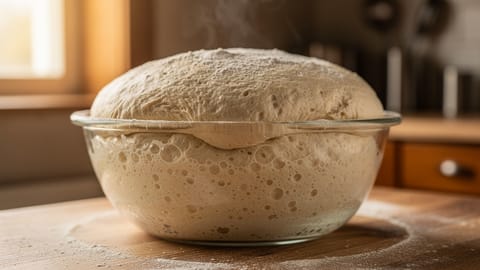
- Volume: Dough has doubled or nearly doubled in size
- Surface: Smooth, slightly domed, not collapsed
- Bubbles: Small bubbles visible on surface and when cut
- Color: Slight deepening of color, creamy appearance
- Edges: Dough pulls away slightly from container sides
Tactile indicators:
- Poke test: Finger indentation slowly springs back halfway
- Feel: Soft, pillowy, not dense or hard
- Stretch: Extends easily without tearing
- Temperature: Slightly warm to touch (room temp) or cold but pliable (cold ferment)
- Gas retention: Holds shape when gently handled
Smell indicators:
- Pleasant aroma: Slightly sweet, bready, yeasty
- No alcohol smell: Strong alcohol means over-fermentation
- Mild tanginess: Acceptable for longer fermentations
- Fresh: Not sour or unpleasantly acidic
The windowpane test:
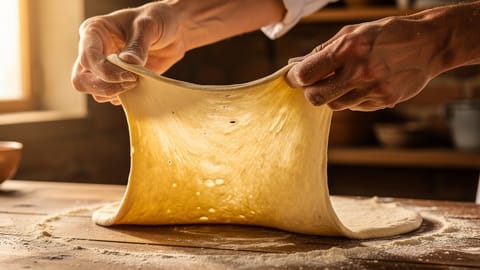
Take a small piece of dough and stretch it gently between your fingers. Properly fermented dough with good gluten development should stretch thin enough to see light through it without tearing.
Tip: Take a photo of your dough at each stage of fermentation. Over time, you will build a visual library that makes it easy to judge readiness at a glance, which is far more reliable than any timer.
Over-fermentation and under-fermentation
Knowing the signs of improper fermentation helps you troubleshoot and adjust future batches. For more diagnostic techniques and fixes, see our pizza dough troubleshooting guide.
Signs of over-fermentation:
- Collapsed structure: Dough looks deflated, flat
- Strong alcohol smell: Yeast is exhausted
- Extremely sticky: Lost structure, overly acidic
- Tears easily: Gluten broken down too much
- Sour taste: Too much acid production
- Poor oven spring: No energy left for final rise
Rescuing over-fermented dough:
- Use immediately, don't let it sit longer
- Reshape very gently to preserve remaining gas
- Expect less rise and different texture
- Consider using for flatbreads or focaccia instead
Signs of under-fermentation:
- Dense texture: Hasn't expanded enough
- Resistant to stretching: Snaps back aggressively
- Lack of flavor: Tastes flat, just like flour
- Yeasty flavor: Raw yeast taste dominates
- Poor digestibility: Causes bloating or discomfort
Rescuing under-fermented dough:
- Allow more time at room temperature
- Move to a warmer location (75-80°F)
- Perform additional stretch-and-fold sets
- Be patient, don't rush the process
I once pulled dough out of the fridge after only 18 hours thinking it would be fine. The crust was bland, tough to stretch, and my stomach let me know about it later. Since then, I never go under 36 hours for cold ferment: the flavor and digestibility difference is that significant.
Pizza dough fermentation and digestibility
This deserves its own section because it is one of the most overlooked benefits of proper pizza dough fermentation, and probably the most important one for your everyday enjoyment of pizza.
Long fermentation breaks down gluten and complex carbohydrates into simpler compounds that your digestive system handles easily. The yeast and beneficial lactic acid bacteria do hours of pre-digestion work, converting hard-to-process starches and proteins into forms your body absorbs without complaint. Research from King Arthur Baking confirms that extended fermentation reduces the FODMAP content that causes digestive issues in many people.
This is why you can eat several slices of properly fermented pizza without discomfort. No bloating, no heaviness, no food coma. Compare that to a fast-rise pizza where the dough has barely had time to develop, and your stomach has to do all the work that fermentation should have done.
If you or someone you know claims to be "sensitive to pizza" or "sensitive to bread," have them try a 48-hour cold-fermented dough. The difference is often striking. Long fermentation does not eliminate gluten (it is still there), but it significantly reduces the compounds that cause digestive distress in many people.
The bottom line: time is an ingredient. The hours your dough spends fermenting are not idle waiting. They are active transformation that makes your pizza better in every way.
Master pizza dough fermentation: key takeaways
Pizza dough fermentation is the difference between forgettable pizza and the kind that keeps you coming back. Here is what to remember:
- Slow fermentation wins. Whether you choose room temperature or cold, give your dough enough time to develop real flavor and improve digestibility.
- Time and temperature are inverse. Warmer means faster. Colder means slower. Use this relationship to fit pizza dough fermentation into your schedule.
- Reduce yeast for longer ferments. Same-day pizza needs 0.3-0.5% instant dry yeast. A 48-72 hour cold ferment needs just 0.1-0.15%.
- Read your dough, not just the clock. Look for doubled volume, a smooth surface, and the poke test springing back halfway.
- The hybrid approach is the sweet spot. Bulk ferment at room temperature for 2-4 hours, then cold ferment as dough balls for 24-72 hours.
Ready to dial in your next batch? Use our pizza dough calculator to get exact flour, water, salt, and yeast amounts for any fermentation schedule: whether you are making beginner pizza dough or pushing a 72-hour cold ferment. For help with hydration levels and overnight methods, check our pizza dough FAQ for quick answers.
Frequently Asked Questions
It depends on the method. Room temperature (68-78°F): 4-8 hours with 0.3-0.5% instant yeast. Cold fermentation (38-42°F): 24-72 hours with 0.1-0.15% instant yeast. The sweet spot for flavor is 48-72 hours cold. Less yeast and more time always produces better-tasting pizza.
Fermentation is the entire biological process where yeast produces CO2, alcohol, and flavor compounds. Proofing (or 'the final proof') specifically refers to the last rise after you've shaped your dough balls. Bulk fermentation is the first rise before dividing. All proofing is fermentation, but not all fermentation is proofing.
Yes. Over-fermented dough collapses when touched, smells strongly of alcohol, tears easily, and won't hold its shape. At room temperature with standard yeast, this happens after 8-12 hours. In the fridge with reduced yeast, dough can safely ferment for 72+ hours before over-fermenting.
For flavor and texture, yes. Cold fermentation develops complex, nutty, slightly tangy flavors that same-day dough can't match. The slow enzyme activity also improves browning, digestibility, and makes the dough easier to stretch. The trade-off is time — you need to plan 1-3 days ahead.
Room temperature: 68-78°F (20-26°C) for active fermentation in 4-8 hours. Cold: 38-42°F (3-6°C) for slow fermentation over 24-72 hours. Avoid temperatures above 85°F (29°C), which cause over-fermentation, or below 35°F (2°C), where fermentation nearly stops.
Look for three signs: the dough has roughly doubled in size, the surface is smooth and slightly domed, and the poke test shows a slow, partial spring-back. If the indent fills back quickly, it needs more time. If the indent stays put, it's over-fermented.
Yes, but use much less. For a 48-72 hour cold ferment, use only 0.1-0.15% instant yeast (about 0.5-0.75g per 500g flour). Standard instant yeast works fine — just avoid 'rapid-rise' varieties, which are designed for speed and skip the flavor-building stage.
Gently degas the dough, reshape it into tight balls, and let it proof again for 30-45 minutes. The result won't be perfect — expect less oven spring and a denser crumb, but it's usable. If it smells strongly of alcohol and won't hold shape at all, use it for flatbread or focaccia instead.
Bulk fermentation is the first rise where all the dough ferments together in one container — this is where most flavor develops. Ball fermentation happens after dividing into individual portions, letting each dough ball relax and develop structure. Most pro methods use both: 2-4 hours bulk, then 24-72 hours as balls in the fridge.
Yes. Research from King Arthur Baking shows that extended fermentation reduces FODMAP content — the compounds that cause bloating and digestive discomfort. The yeast and enzymes pre-digest complex carbohydrates during those long hours, so your body doesn't have to. A 48-hour dough is dramatically easier on digestion than a 2-hour one.
Sources
Cook smarter
Join the waitlist for Fond. Recipes, meal plans, and a little AI sous-chef that learns how you cook.
Related guides
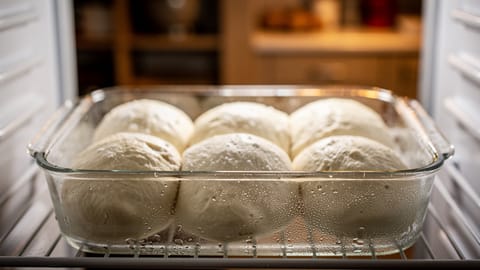
Cold Fermentation Pizza Dough Guide
Slow-rise your dough in the fridge for 24, 48, or 72 hours. The longer it sits, the more complex the flavor gets. Most home bakers hit the sweet spot at 48 hours with 0.1% fresh yeast.
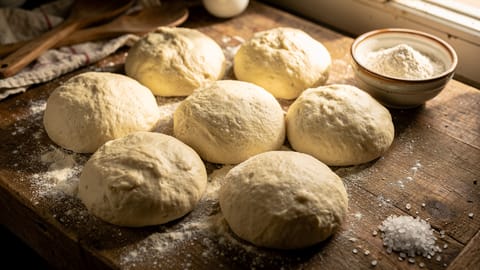
Neapolitan Pizza Dough
Neapolitan dough the way Naples does it: 00 flour, 60-62% hydration, long fermentation, and extreme heat. This guide follows AVPN standards and adapts them for home ovens, including flour brands, fermentation schedules, and a full troubleshooting section.
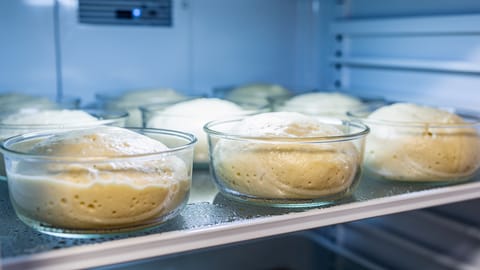
Overnight Pizza Dough
Mix the dough before bed, refrigerate it, bake pizza the next day. 10 minutes of work the night before, and you get better flavor than same-day dough with zero extra effort.
Pizza Dough FAQ
Quick answers to 25+ pizza dough questions. How long to let it rise, can you freeze it, what to do when it's too sticky, how to store it. Each answer leads with the "what to do" before the "why."
Pizza dough hydration: complete guide to water ratios
How the water-to-flour ratio shapes your crust. 60% gives you a stiff, easy-to-handle dough; 75%+ gives you open, airy crumb but requires more technique. Includes baker's percentages by style, a decision framework, bassinage technique, and fermentation interaction.
Pizza Dough Troubleshooting: Common Problems & Fixes
Dough too sticky? Won't stretch? Bland crust? Tearing during shaping? This guide covers the most common headaches and what's actually going wrong, with quick fixes you can try right now.

Fermentation
A metabolic process where microorganisms convert sugars into acids, gases, or alcohol — the basis of bread, yogurt, kimchi, and beer.
Bulk Fermentation
The primary rise of bread dough after mixing, where yeast or starter ferments the dough as a single mass before shaping.