 Bastien
Pizza Flour Guide: 00, Bread Flour, AP & Protein Content
00 vs. bread flour vs. all-purpose: what actually matters is protein content and how it matches your pizza style. Includes W values, brand recommendations, and a style-to-flour matching table.
TL;DR: The best flour for pizza dough depends on your style. Match protein content to what you're making — 00 flour (11-13% protein) for Neapolitan, bread flour (12-14%) for NY-style and pan pizzas, all-purpose (9-11%) for beginners. Higher protein handles longer fermentation; W values measure flour strength more precisely than protein alone. Use the pizza dough calculator to dial in exact ratios once you've picked your flour.
Why pizza flour matters
Flour accounts for 90% of your dough by weight and has more impact on your final crust than any other single choice. The type you use determines texture, structure, chewiness, crispness, and how the dough behaves in your hands. I noticed this firsthand when I switched from grocery store all-purpose to a proper 00 flour — same recipe, same oven, but the dough stretched like silk instead of fighting back, and the crust came out with a completely different chew.
Different flours contain varying amounts of protein, ash content, and particle sizes: all of which affect gluten development, fermentation speed, browning, and crust texture. Once you know what these numbers mean, picking the right flour becomes straightforward.
Types of pizza flour
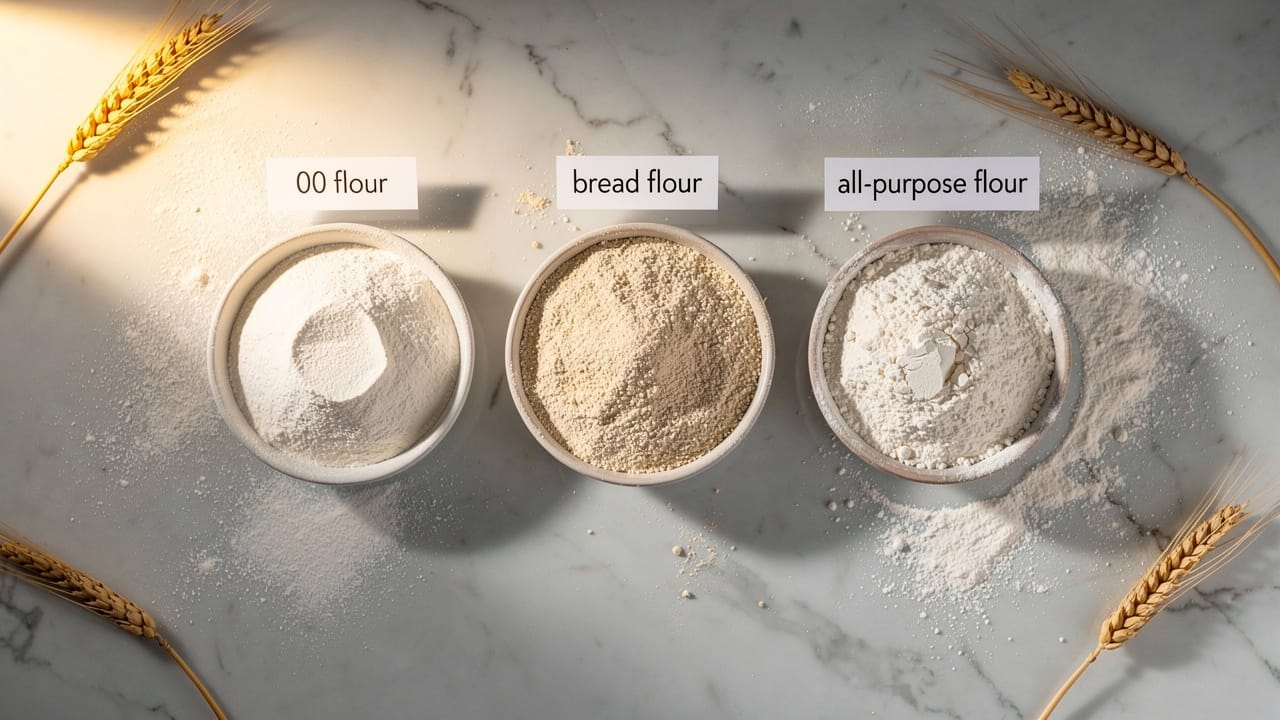
Type 00 Flour (Doppio Zero)
Origin: Italian classification based on ash content and grind fineness
Characteristics:
- Ultra-fine grind: Feels silky and smooth, almost like powder
- Protein content: Typically 11-13% (varies by brand)
- Ash content: Very low (0.55% or less)
- Gluten development: Produces extensible, elastic dough that's easy to stretch
- Texture: Creates soft, tender crusts with delicate crumb
Best for: Neapolitan pizza, thin-crust pizzas, high-temperature baking (800°F+/425°C+)
What to look for: A 00 flour with 12-13% protein and W 260-280. These are widely available from Italian mills and increasingly from local producers.
Type 00 flour is the standard for Neapolitan pizza. Its fine grind hydrates quickly and produces a smooth, extensible dough that's easy to hand-stretch into thin rounds that puff in ultra-hot ovens.
Bread flour
Origin: American/British classification based on protein content
Characteristics:
- Coarser grind: More texture than 00 flour
- Protein content: 12-14% (higher than all-purpose)
- Stronger gluten: Produces chewier, more structured dough
- Better gas retention: Holds air bubbles well during fermentation
- Browning: Darker crust color than 00 flour
Best for: New York-style pizza, thick crusts, pan pizzas, longer fermentations, home ovens (500-550°F/260-290°C)
What to look for: A bread flour with 12-13% protein. In Europe, look for T65 or strong bread flour (farine de gruau). In the US, most bread flours from major mills fall in this range.
Bread flour's higher protein builds stronger gluten networks that hold up through longer fermentation and support the structure needed for thicker, larger pizzas. It's the standard choice for American-style pizza.
All-purpose flour
Origin: General-purpose American flour
Characteristics:
- Protein content: 9-11% (varies by brand and region)
- Versatile performance: Acceptable for most pizza styles
- Moderate gluten: Less chewy than bread flour, less delicate than 00
- Widely available: Found in every grocery store
- Cost-effective: Most affordable option
Best for: Home pizza-making, beginner bakers, thin to medium crusts, standard home oven temperatures
What to look for: An all-purpose flour with 9-11% protein. Protein content varies widely between brands and regions, so check the nutrition label.
All-purpose flour is fine for home pizza, especially when you're getting started. It won't match a specialty flour, but it gives decent results without any sourcing hassle.
Semolina flour
Origin: Durum wheat milling product
Characteristics:
- Coarse texture: Gritty, sandy feel
- High protein: 12-13%
- Yellow color: Gives dough a golden hue
- Slow hydration: Takes time to absorb water
- Distinctive flavor: Slightly nutty and sweet
Best for: Blending with other flours (10-20%), dusting work surfaces, Detroit-style pizza, Roman pizza al taglio
Not recommended as 100% of flour: Too coarse and tough when used alone
Semolina works as a blend ingredient, not a base. Adding 10-20% to your dough adds flavor, improves browning, and makes the crust slightly crispier. It's also the best option for dusting peels and work surfaces: it doesn't burn as fast as regular flour.
Comparison table: pizza flour types at a glance
| Flour Type | Protein % | Grind | Best For | Texture | Price |
|---|---|---|---|---|---|
| Type 00 | 11-13% | Ultra-fine | Neapolitan, thin crust | Soft, delicate, extensible | $$$ |
| Bread Flour | 12-14% | Medium | NY-style, thick crust | Chewy, structured | $$ |
| All-Purpose | 9-11% | Medium-fine | General use, beginners | Moderate chew | $ |
| Semolina | 12-13% | Coarse | Blending, dusting | Crispy, nutty | $$ |
| Whole Wheat | 13-15% | Varies | Artisan blends (10-30%) | Dense, nutty | $$ |
00 flour vs bread flour: head-to-head
This is the most common comparison for home pizza makers deciding between the two most popular pizza flours.
Understanding protein in pizza flour
What is protein in flour?
Flour protein consists primarily of glutenin and gliadin: two proteins that form gluten when mixed with water and kneaded. Gluten provides the elastic structure that traps gas bubbles during fermentation, giving dough its rise and chew.
Protein percentage ranges
- Low protein (9-10%): Produces tender, cake-like textures; less suitable for pizza
- Medium protein (11-12%): Balanced texture; good for thin crusts and Neapolitan styles
- High protein (13-14%): Strong structure; ideal for chewy, thick crusts and long fermentation
A note on protein labeling
Here is something that trips up a lot of home pizza makers: protein content is not always listed on retail flour bags. Most consumer packaging only shows total protein per serving on the nutrition panel, which you can convert, but professional bakery flour almost never lists protein percentage on the bag at all. You need to know your local flours. Learning which mills and flour types produce what characteristics is genuinely part of the craft: there is no shortcut here. Once you get familiar with a handful of flours available in your area, you will start to feel the difference in the dough before you even check any numbers.
Tip: To calculate protein percentage from a nutrition label, divide grams of protein per serving by grams per serving, then multiply by 100. For example, 4g protein in a 30g serving = 13.3% protein.
Matching protein to fermentation length
This is one of the most practical things to understand: your flour's protein content needs to match your fermentation schedule.
- Up to 36 hours fermentation: 12.5-13% protein works well. The gluten network holds up through an overnight or day-long cold ferment without any issues.
- 36-48 hours fermentation: Step up to 13-14% protein. Longer fermentation means more enzymatic activity breaking down gluten, and you need that extra protein to maintain structure.
Higher protein gives the dough more staying power during extended fermentation. After ruining a batch of 72-hour cold-fermented dough balls with a 10.5% protein all-purpose flour: they turned into flat, sticky discs that were impossible to stretch. I learned this lesson the hard way. If you have ever had a dough go slack and sticky after two days in the fridge, you were probably using a flour that was too weak for that timeline. Match the protein to the ferment, and that problem goes away. If you're running into other issues, check our pizza dough troubleshooting guide.
How protein affects pizza dough
Higher protein = stronger gluten = chewier crust
High-protein doughs:
- Develop more gluten structure
- Handle extended fermentation better
- Create chewier, more bread-like crusts
- Hold shape better during stretching
- Support heavier toppings
Lower protein = weaker gluten = tender crust
Lower-protein doughs:
- Produce more delicate, crisp textures
- Stretch more easily (more extensible)
- Work well for thin, fast-baked pizzas
- Create softer, less chewy results
Matching pizza flour protein to style
- Neapolitan (800-900°F/425-480°C): 11-12.5% protein (00 flour)
- New York-style (550-600°F/290-315°C): 12.5-13.5% protein (bread flour)
- Detroit/Pan pizza: 13-14% protein (high-gluten bread flour)
- Thin & crispy: 10-11% protein (all-purpose or low-protein 00)
W values explained
What is the W value?
The W value (also called Alveograph W or strength index) measures flour's strength and elasticity: specifically, how much force is required to stretch dough until it breaks. This test simulates the stress dough experiences during fermentation and shaping.
W values are common in Europe, particularly Italy, but rarely appear on American flour packaging. However, understanding W values helps you evaluate imported flours and understand professional pizza-making discussions.
W value ranges
| W Value | Strength | Fermentation Time | Best Use |
|---|---|---|---|
| 90-160 | Very Weak | 2-4 hours | Biscuits, pastries |
| 160-200 | Weak | 4-8 hours | Short fermentation pizza |
| 200-280 | Medium | 8-24 hours | Neapolitan, medium fermentation |
| 280-350 | Strong | 24-48 hours | NY-style, long fermentation |
| 350+ | Very Strong | 48-72+ hours | Panettone, bagels, extended fermentation |
Typical W values by flour type
- Standard 00 pizza flour: W 260-280 (medium-strong, 24-hour fermentation)
- Strong 00 pizza flour: W 300-320 (strong, extended fermentation)
- Bread flour (12-13% protein): Estimated W 280-300 (strong)
- High-gluten bread flour (14%+): Estimated W 320+ (very strong)
Why W values matter for pizza flour
Flours with similar protein percentages can have vastly different W values. A 12.5% protein 00 flour might have a W of 260, while a 12.7% bread flour has an effective W of 300+. The higher the W value, the longer the flour can ferment without over-developing and becoming slack or sticky.
Best flour for pizza dough by style
Neapolitan pizza
Recommended: Type 00 flour, 11-13% protein, W 260-280
Why: The fine grind and medium protein content create the characteristic soft, leopard-spotted, puffy crust that's both tender and chewy. The extensibility allows for easy hand-stretching into thin rounds.
What to use: Any quality 00 flour with 12-13% protein and W 260-280 from a reputable mill.
New York-style pizza
Recommended: Bread flour, 12.5-14% protein, W 280-320
Why: Higher protein creates the structured, chewy crust that can support generous toppings and fold in half without breaking. Strong gluten handles longer fermentation for complex flavor development.
What to use: A strong bread flour with 12.5-14% protein. High-gluten bread flour (13.5%+) is ideal if you can find it.
Detroit-style / Pan pizza
Recommended: High-protein bread flour, 13-14% protein
Why: The thick, focaccia-like crust requires strong gluten structure to rise properly and create the crispy bottom characteristic of Detroit pizza.
What to use: The strongest bread flour you can find: high-gluten flour with 14%+ protein is ideal. Look for flour labeled "high-gluten" or "strong bread flour."
Roman pizza al taglio
Recommended: 00 flour or bread flour blend, 12-13% protein, with 10-20% semolina
Why: The airy, high-hydration dough needs strong enough gluten to handle 80%+ hydration while maintaining structure. Semolina adds flavor and crispness.
What to use: A strong 00 flour (W 300+) or bread flour (13%+ protein) blended with 10-20% semolina.
Thin & crispy pizza
Recommended: All-purpose or lower-protein 00 flour, 10-11% protein
Why: Lower protein creates tender, crisp textures without excessive chew. Less gluten development means the dough stays flatter and crisper.
What to use: Any all-purpose or low-protein 00 flour with 10-11% protein.
What flour do pizzerias use?
Walk into any serious Neapolitan pizzeria and you will find bags of Italian 00 flour: usually W 260-300, sourced from mills that have been grinding wheat for generations. The AVPN (Associazione Verace Pizza Napoletana) specifically requires Type 00 or Type 0 flour for certified Neapolitan pizza.
American pizza shops tell a different story. Most NY-style places use high-gluten bread flour with 13-14.5% protein: the same heavy-duty flour used for bagels and hearth breads. It handles the longer ferments, supports heavy toppings, and delivers that characteristic fold-and-chew that New Yorkers expect.
I talked to a couple of local pizzeria owners while researching this guide, and the common thread was surprising: none of them obsessed over brand names. They cared about consistency: getting the same protein content and behavior from bag to bag. One owner told me he switched mills three times in a year before finding one whose flour performed the same way every single week. That consistency matters more than any label.
For home pizza makers, the takeaway is practical: you do not need the exact flour your favorite pizzeria uses. What matters is matching the protein level and flour type to your style and oven. A grocery store bread flour and a no-knead approach will get you closer to great pizza than an expensive imported 00 in a cold home oven.
How to choose the right pizza flour
What to look for on the label
The most important thing is protein content. Here is what to look for by pizza style:
| Pizza Style | Protein % | Flour Type | W Value |
|---|---|---|---|
| Neapolitan | 12-13% | Type 00 | W 260-280 |
| New York-style | 12.5-14% | Bread flour | W 280-320 |
| Detroit / Pan | 13-14%+ | High-gluten bread flour | W 320+ |
| Roman al taglio | 12-13% | 00 or bread flour + semolina | W 280-320 |
| Thin & crispy | 10-11% | All-purpose or low-protein 00 | W 160-200 |
Sourcing tips
- In Italy and much of Europe: Look for farine labeled with their W value. This is the most reliable way to choose. A W 260-280 flour is your everyday pizza flour; W 300+ is for long fermentation.
- In France: T55 is roughly equivalent to all-purpose, T65 to bread flour. Farine de gruau is the strongest option available.
- In the UK: "Strong bread flour" is the equivalent of bread flour. "Very strong bread flour" (14%+ protein) is ideal for pan pizzas and long ferments.
- In the US: Bread flour is widely available. High-gluten flour (14%+) can be found at specialty baking suppliers or restaurant supply stores.
- Anywhere: Ask your local mill or bakery supplier about protein content and W values. Specialty flour from a reputable mill is worth the investment once you are making pizza regularly.
Budget-friendly options
Most grocery store bread flours (12-13% protein) produce good results for home pizza-making. Check protein content on the nutrition label. You do not need specialty flour to make great pizza at home: understanding protein content matters far more than the brand name on the bag. Use the pizza dough calculator to get your baker's percentages right with whatever flour you choose.
Ancient grain and alternative pizza flours
Ancient grain flours
For those pushing into California-style innovation or artisan territory, ancient grain flours open up a whole different flavor profile:
- Khorasan (Kamut): Rich, buttery, slightly sweet. Adds a golden color and a distinctive nutty depth. Works well at 15-25% of total flour weight blended with bread flour or 00.
- Einkorn: The oldest cultivated wheat. Lower gluten strength but incredible flavor: earthy, almost honey-like. Use at 10-20% blended; it cannot carry a dough on its own due to weak gluten.
- Sprouted wheat: Sweeter, more digestible, with a subtle malty note. Sprouted flour absorbs water differently, so expect to reduce hydration by 5-10% compared to your normal formula.
These grains require adjusted hydration and gentler handling. The gluten they form is weaker and less elastic than modern wheat, so mix times should be shorter and you should expect a denser, more irregular crumb. That is not a flaw: it is the character. If you want a pizza that tastes like something beyond the ordinary, ancient grains deliver.
Multigrain dough as a legitimate style
Mixing small percentages of whole wheat, rye, or spelt into your base flour is not a health-food compromise: it is a legitimate pizza style that adds real complexity to your crust.
- 10-15% whole wheat: Adds a subtle earthiness and slightly darker color without dramatically changing structure. Works with any style.
- 5-10% rye: Brings a distinctive tangy, almost sour note. Rye has very little gluten-forming protein, so keep the percentage low.
- 10-20% spelt: Nutty, sweet, slightly more delicate than whole wheat. Spelt gluten is fragile, so handle gently and do not overwork the dough.
The key is keeping alternative flours to 10-20% of total flour weight. At these levels, you get flavor complexity and visual interest without compromising the gluten structure you need for a good rise and proper oven spring. Go above 25% and you start fighting the dough rather than working with it.
Pizza flour storage tips
Proper storage conditions
Temperature: Store flour in a cool, dry place (60-70°F/15-21°C)
Moisture: Keep flour away from humidity and water sources. Moisture causes clumping and can lead to mold growth.
Container: Transfer flour to airtight containers to prevent pest infestation and moisture absorption. Glass, plastic, or metal containers all work well. A kitchen scale is essential for weighing flour accurately.
Shelf Life:
- White flour: 6-8 months at room temperature, 1-2 years refrigerated
- Whole grain flour: 3-4 months at temperature, 6-8 months refrigerated (oils in the bran can go rancid)
Refrigerator vs. pantry storage
Room temperature storage is perfectly fine for flour you'll use within a few months. Refrigerator or freezer storage extends shelf life significantly, especially important for:
- Whole grain flours
- Specialty flours used infrequently
- Bulk purchases
- Hot, humid climates
Important: Let refrigerated flour come to room temperature before using. Cold flour will slow yeast activity and affect hydration rates.
Tip: Label your flour containers with the purchase date and protein percentage. When you find a flour you like, note the brand and mill so you can buy it consistently.
Signs of flour gone bad
Cause: Oils in the flour (especially whole grain) have oxidized, or moisture caused mold spores.
Fix: Discard it. Rancid flour will give your dough an off-flavor that baking won't fix.
Cause: Moisture got into the container, causing the starch to bind.
Fix: If there are only a few small clumps and no smell, sift and use. If clumps are widespread, discard.
Cause: Flour beetles or pantry moths: often present as eggs in the flour from the mill.
Fix: Discard the flour and clean the storage area. To prevent this, freeze new flour for 48 hours before transferring to containers.
Final pizza flour tips
Start with bread flour or all-purpose while you learn the process. Specialty flour is worth it once you know what you're doing. Our beginner pizza dough guide walks through a first recipe step by step.
Match flour to your oven: high-heat ovens (700°F+/370°C+) suit 00 flour. Standard home ovens (500-550°F/260-290°C) do better with bread flour. See our pizza equipment guide for oven recommendations.
Try blends once you're comfortable: 80% bread flour + 20% semolina, or 70% 00 + 30% bread flour. Both are worth experimenting with.
One thing people overlook: your water. Hard water strengthens gluten; soft water weakens it. If your dough is consistently tighter or slacker than expected, your water mineral content may be part of the reason.
Once your flour matches your style and oven, the difference is immediate: in texture, flavor, and how the dough handles. Nothing else you adjust will have as much impact. If you are planning an overnight dough, a sourdough pizza, or experimenting with a poolish or biga pre-ferment, getting the flour right is the foundation everything else builds on. Browse all pizza dough guides to keep refining your craft.
- Match flour protein to your pizza style: 00 (11-13%) for Neapolitan, bread flour (12-14%) for NY-style, all-purpose (9-11%) for beginners
- W values measure flour strength more precisely than protein alone: higher W handles longer fermentation
- You don't need expensive flour to make great homemade pizza: understanding protein content matters more than brand names
- Store flour in airtight containers, and refrigerate specialty or whole grain flours
- Start with bread flour in a home oven, then experiment with 00 flour and blends as you gain experience
Frequently Asked Questions
The best pizza flour depends on your style. For Neapolitan pizza baked at 800°F+, use Type 00 flour with 12-13% protein and W 260-280. For New York-style in a home oven at 500-550°F, use bread flour with 12.5-14% protein. For beginners or general home pizza, all-purpose flour (9-11% protein) works fine. The key is matching protein content to your pizza style and fermentation time.
00 flour has an ultra-fine grind and typically 11-13% protein, producing soft, extensible dough ideal for Neapolitan pizza at high temperatures. Bread flour has a coarser grind with 12-14% protein, creating chewier, more structured dough that works better in home ovens and for thicker crusts like NY-style. The main differences are grind fineness, gluten behavior, and which oven temperatures they perform best at.
Yes, all-purpose flour (9-11% protein) makes decent pizza, especially for beginners. It produces a softer, less chewy crust compared to bread flour or 00 flour. For better results, look for a higher-protein all-purpose flour (closer to 11%). As you improve, switching to bread flour or 00 flour will noticeably upgrade your crust texture and structure.
The W value (Alveograph W) measures flour strength — how much force is needed to stretch dough until it breaks. Higher W values mean the flour can handle longer fermentation without becoming slack. W 200-280 suits 8-24 hour fermentation (Neapolitan), W 280-350 handles 24-48 hours (NY-style), and W 350+ supports 48-72+ hours. W values are common on European flour but rare on American packaging.
For Neapolitan pizza: 11-12.5% protein. For NY-style: 12.5-13.5%. For Detroit/pan pizza: 13-14%+. For thin and crispy: 10-11%. Higher protein creates stronger gluten and chewier crust; lower protein creates softer, more tender crust. Match protein to your fermentation time too — longer ferments need higher protein to maintain structure.
No — you can make good pizza with regular grocery store bread flour or all-purpose flour. Specialty flour like Type 00 makes a noticeable difference for specific styles (especially Neapolitan), but understanding protein content matters more than buying expensive brands. Start with whatever bread flour is available, learn the process, then experiment with specialty options.
Most Neapolitan pizzerias use Type 00 flour with W 260-300 from Italian mills. American pizza shops typically use high-gluten bread flour with 13-14.5% protein — the same type of flour used for bagels and hearth breads. Many pizzerias buy 50-lb bags from restaurant supply distributors rather than retail brands.
Yes, blending flours is a common technique among experienced pizza makers. Popular blends include 80% bread flour + 20% semolina for added crunch and flavor, 70% Type 00 + 30% bread flour for a balance of softness and structure, and 85% bread flour + 15% whole wheat for earthy depth. Keep alternative flours under 20% of total weight to maintain good gluten structure.
For thin and crispy pizza, use lower-protein flour: all-purpose (9-11% protein) or a low-protein Type 00. Less protein means less gluten development, which keeps the crust flat and snappy rather than chewy. Roll the dough thin, use minimal toppings, and bake at the highest temperature your oven allows. Adding 10% semolina to the blend also boosts crispness.
Sources
Cook smarter
Join the waitlist for Fond. Recipes, meal plans, and a little AI sous-chef that learns how you cook.
Related guides
Beginner Pizza Dough
Your first homemade pizza dough, from scratch. A simple same-day recipe with 4 ingredients, plus everything you need to know about mixing, kneading, and shaping.
Cold Fermentation Pizza Dough Guide
Slow-rise your dough in the fridge for 24, 48, or 72 hours. The longer it sits, the more complex the flavor gets. Most home bakers hit the sweet spot at 48 hours with 0.1% fresh yeast.
Neapolitan Pizza Dough
Neapolitan dough the way Naples does it: 00 flour, 60-62% hydration, long fermentation, and extreme heat. This guide follows AVPN standards and adapts them for home ovens, including flour brands, fermentation schedules, and a full troubleshooting section.

New York Style Pizza Dough
Big, foldable slices with a crispy bottom and chewy bite. NY-style dough uses high-gluten flour, a touch of oil and sugar, and a 48-hour cold ferment for that classic slice-shop flavor.
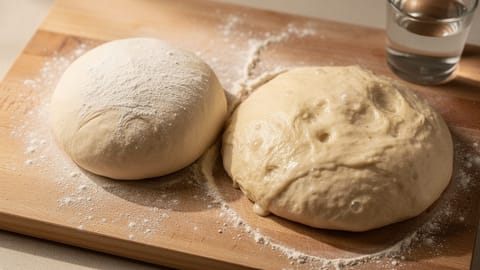
Pizza dough hydration: complete guide to water ratios
How the water-to-flour ratio shapes your crust. 60% gives you a stiff, easy-to-handle dough; 75%+ gives you open, airy crumb but requires more technique. Includes baker's percentages by style, a decision framework, bassinage technique, and fermentation interaction.
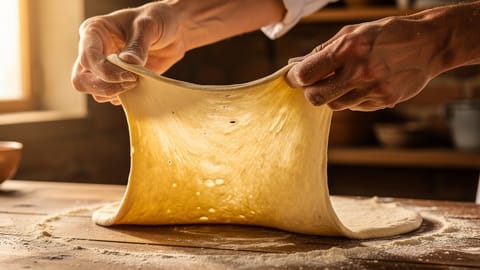
Pizza Dough Troubleshooting: Common Problems & Fixes
Dough too sticky? Won't stretch? Bland crust? Tearing during shaping? This guide covers the most common headaches and what's actually going wrong, with quick fixes you can try right now.
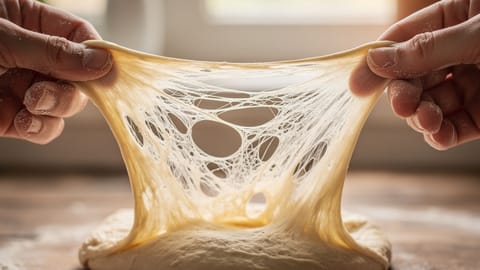
Gluten Development
The process of building a protein network in dough through kneading, folding, or time, creating the structure that gives bread its chew and allows it to rise.