 Bastien
Dutch oven recipes: 20 essential dishes to master
A Dutch oven is the most versatile pot in your kitchen. These 20 essential recipes — organized by technique — cover braised meats, soups, no-knead bread, and more, plus the temperatures, times, and tips you need to make each one well.
A Dutch oven is the most versatile pot in your kitchen, and it's probably underused. Those heavy cast iron walls and tight-fitting lid do something no other piece of cookware does quite as well: they hold heat evenly, trap moisture, and move from stovetop to oven without missing a beat. The result is food that tastes deeply, consistently better — braised meats that fall apart, soups with layered flavor, and crusty bread that rivals a bakery.
But most Dutch oven recipe lists just throw 50 dishes at you without explaining why this pot makes them better. That's a missed opportunity. Understanding the techniques behind Dutch oven cooking means you can adapt any recipe, not just follow a list. Here are 20 simple Dutch oven recipes organized by technique, plus the temperatures, times, and tips you need to make each one well.
Why a Dutch oven changes everything
A Dutch oven works because of physics. The thick cast iron walls absorb heat slowly and release it evenly, eliminating the hot spots that scorch food in thinner pots. That heavy lid traps steam inside, creating a self-basting environment where moisture circulates back onto your food instead of escaping into the air.
This matters most for two things: tough cuts of meat and bread. For braises, the steady low heat breaks down collagen in connective tissue over hours, turning a cheap chuck roast into something silky and rich. For bread, the trapped steam during the first 20 minutes of baking creates the crispy, blistered crust you see in artisan loaves — a crust that's nearly impossible to achieve in a regular oven without a commercial steam injection system.
The Maillard reaction also benefits from cast iron's heat retention. When you sear meat in a Dutch oven, the temperature recovers faster after you add cold protein. Less temperature drop means better browning, and better browning means deeper flavor. I've tested this side by side with a stainless steel pot, and the difference in crust color alone is striking.
Cast iron Dutch oven cooking techniques
Braising
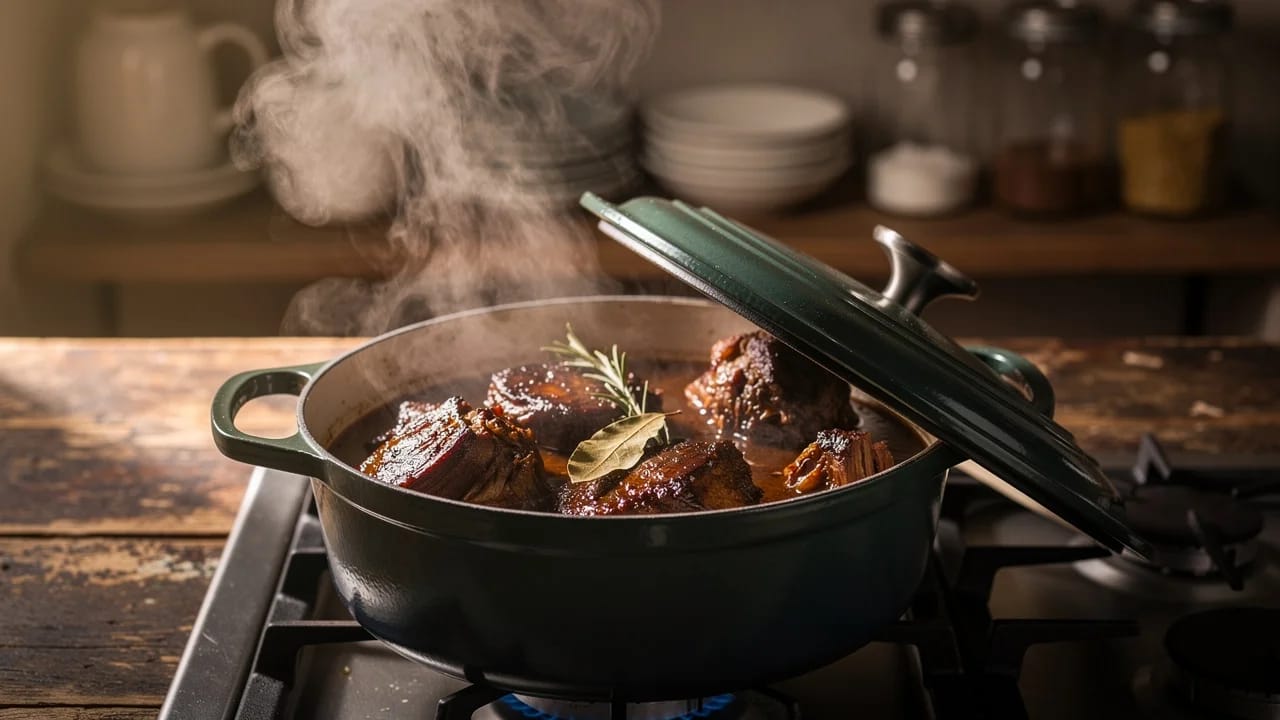
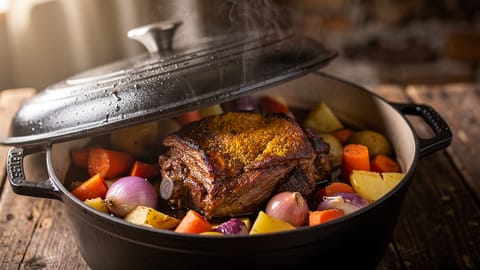
Braising is what Dutch ovens were born to do. The method is simple: sear your protein in fat until deeply browned, remove it, build a flavor base with aromatics, add liquid halfway up the meat, cover, and cook low and slow in the oven at 300-325°F (150-160°C) for two to four hours. If you want to go deeper on the technique, our guide to braising meat covers the full process.
The keys to a great braise are patience and restraint. Don't rush the sear — give each side a solid 3-4 minutes without moving it. Use just enough liquid to come halfway up the meat, not cover it. The exposed top roasts while the submerged portion braises, giving you two textures in one dish. Best candidates: short ribs, pork shoulder, chicken thighs, and lamb shanks.
One-pot simmering
Soups, stews, and chili all benefit from the Dutch oven's even heat. This is one-pot cooking at its best. Start by browning your aromatics and any meat in the pot, then deglazing with wine, broth, or even water to lift those caramelized bits off the bottom. Those browned bits — the fond — are concentrated flavor waiting to dissolve into your liquid.
Layer your ingredients by cook time: dense root vegetables go in first, delicate greens and herbs go in during the last 10 minutes. Keep the heat at medium-low on the stovetop. A Dutch oven holds heat so well that medium-low is usually all you need. After making dozens of soups in mine, I've learned that fighting the urge to crank the heat is the single biggest improvement most people can make.
Bread baking
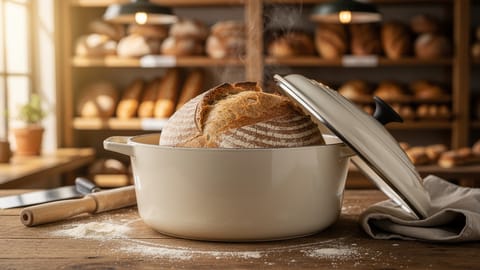
This is the technique that converted a generation of home bakers. A preheated Dutch oven mimics a professional steam-injected oven. You heat the empty pot at 450°F (230°C) for 30 minutes, drop in your dough, cover, and bake for 30 minutes with the lid on. Then remove the lid and bake another 15-20 minutes for color and crust development.
The trapped steam keeps the dough's surface moist during the initial bake, allowing it to expand fully before the crust sets. This is how you get that ear — the ridge where the scoring opens up — and that shattering, crackly crust. The no-knead bread method popularized by Jim Lahey relies entirely on this technique. If you maintain a sourdough starter, the Dutch oven method works even better — wild yeast produces more complex flavors and the steam makes the scoring bloom open dramatically.
Roasting and frying
A Dutch oven handles whole chickens beautifully. Season your bird, place it breast-side up in the pot, and roast uncovered at 375°F (190°C) for about 1 to 1.5 hours, depending on size. The high walls shield the legs from direct heat while the breast gets more exposure, helping both parts finish at the same time.
For deep frying, those tall sides contain splatter and help maintain oil temperature. Fill no more than halfway with oil and use a thermometer to hold 350°F (175°C). Know your oil smoke points — peanut and vegetable oil are your best bets for high-heat frying.
Quick reference: temperatures and times
Best Dutch oven recipes by category
These 20 dishes represent the range of what a cast iron Dutch oven does best. They're organized by technique so you can see the patterns — once you master braising, every braised dish follows the same logic.
Soups and stews
Classic beef stew. Brown cubed chuck roast in batches (don't crowd the pot), soften onions and carrots, add potatoes, broth, and a splash of red wine. Simmer at medium-low for 1.5-2 hours until the beef is fork-tender. Season with thyme and bay leaves. This is one of the simplest Dutch oven recipes, and it rewards patience more than skill.
French onion soup. Slowly caramelize 4-5 large onions in butter for 45-60 minutes over medium-low heat. The Dutch oven's even heat prevents burning during this long, slow process. Deglaze with dry white wine, add beef stock, and simmer for 30 minutes.
Butternut squash soup. Roast cubed squash in the Dutch oven at 400°F (200°C) for 25 minutes, add broth and aromatics, simmer, then blend. The roasting step adds sweetness you won't get from boiling. This is one of my go-to healthy Dutch oven recipes — it needs nothing more than squash, onion, broth, and a pinch of nutmeg.
Minestrone. A true clean-out-the-fridge soup. Saute onion, celery, and garlic, add canned tomatoes, broth, white beans, and whatever vegetables are on hand. Simmer 45 minutes, add small pasta for the last 10.
Braised meats
Beef bourguignon. The French classic that justifies owning a Dutch oven. Sear beef chuck, build a base of onions, carrots, and garlic, pour in a full bottle of red Burgundy wine, and braise at 325°F (160°C) for 2.5-3 hours. Add pearl onions and mushrooms in the last 30 minutes. This is a dish where you can make a pan sauce from the braising liquid by reducing it after removing the meat.
Braised short ribs. Season generously, sear until dark brown on all sides (about 4 minutes per side), and braise in a mix of red wine and beef stock at 325°F (160°C) for 3 hours. The meat should slide off the bone. Beef Dutch oven recipes don't get better than this.
Pulled pork. Rub a 4-5 lb pork shoulder with salt, pepper, smoked paprika, and brown sugar. Sear, add a cup of apple cider vinegar and broth, cover, and cook at 300°F (150°C) for 3.5-4 hours. Shred with two forks.
Coq au vin. Chicken thighs braised in red wine with bacon, mushrooms, and pearl onions. Brown the bacon first, use the rendered fat to sear the chicken, and braise at 325°F (160°C) for 1.5 hours.
Chicken dishes
Dutch oven roast chicken. Pat a whole chicken dry, season inside and out with salt and pepper, and roast at 375°F (190°C) for about 1 hour 15 minutes (until thigh registers 165°F / 74°C). Rest 15 minutes before carving. The Dutch oven keeps the drippings contained for an easy pan gravy.
Chicken cacciatore. Sear bone-in thighs, remove, saute onions and bell peppers, add crushed tomatoes and olives, nestle the chicken back in, and simmer covered for 40-45 minutes on medium-low.
Chicken and dumplings. Make a thick chicken stew with carrots, celery, and peas, then drop biscuit-dough dumplings on the surface. Cover and simmer 15 minutes without lifting the lid — the steam cooks the dumplings through.
One-pot pasta and grains
Bolognese with pappardelle. A proper Bolognese simmers for 2-3 hours, and the Dutch oven's heat retention makes it nearly hands-off. Brown ground beef and pork, add a soffritto of onion, carrot, and celery, pour in crushed tomatoes and a splash of milk, and let it reduce slowly. According to Serious Eats, the key is patience — low heat and time do the work.
Dutch oven risotto. This is the cheat code for risotto. Toast arborio rice in butter, add warm broth in two large additions instead of constant ladling, stir occasionally, and cover between stirs. The even heat does the work. Total time: 25 minutes, and the result is just as creamy as the traditional method.
Mac and cheese. Cook pasta directly in the Dutch oven, drain most of the water, and build a cheese sauce right in the same pot. Butter, flour, milk, sharp cheddar, and a pinch of mustard powder. Transfer to the oven at 375°F (190°C) for 15 minutes for a golden top.
Breads and baked goods
No-knead crusty bread. Mix 3 cups flour, 1.5 tsp salt, 0.25 tsp instant yeast, and 1.5 cups water. Let it sit covered for 12-18 hours at room temperature. Shape, proof for 2 hours, then bake in a preheated 450°F (230°C) Dutch oven — 30 minutes covered, 15 uncovered. The crust will crackle when you tap it. If you're new to baking bread at home, this is the recipe to start with.
Sourdough boule. Same Dutch oven method, but with your sourdough starter in place of commercial yeast. Score the top before dropping it in. The trapped steam makes the scoring bloom open dramatically.
Cinnamon rolls. Arrange risen rolls snugly in a buttered Dutch oven and bake at 350°F (175°C) for 25-30 minutes. The enclosed space keeps them impossibly soft and steamy while the tops turn golden.
Vegetarian and plant-based
Ratatouille. Layer sliced eggplant, zucchini, tomatoes, and bell peppers in the Dutch oven over a base of tomato sauce. Bake covered at 350°F (175°C) for 45 minutes, then uncovered for 15 minutes to concentrate the flavors. A solid vegetarian Dutch oven recipe that tastes better the next day.
Vegetable curry. Bloom spices (cumin, coriander, turmeric, garam masala) in oil, add onions and garlic, then coconut milk and vegetables. Simmer covered for 30-40 minutes. The heavy pot keeps the simmer gentle and even.
Shakshuka. Simmer a spiced tomato-pepper sauce on the stovetop, crack eggs directly into the sauce, cover, and cook for 8-10 minutes until the whites set but the yolks stay runny. Serve straight from the pot with crusty bread.
What not to cook in a Dutch oven
A Dutch oven handles almost everything, but a few things are better done elsewhere. Delicate fish fillets overcook easily in heavy cast iron — a thinner pan gives you more temperature control. Quick stir-fries need the responsiveness of a wok or lightweight skillet; by the time a Dutch oven cools down, your vegetables have turned to mush.
Long-simmered acidic foods (tomato sauce for 4+ hours, heavy wine reductions) can cause problems in bare cast iron. The acid slowly dissolves the seasoning layer and picks up metallic flavors. Enameled Dutch ovens don't have this issue. I once simmered a marinara in an unseasoned cast iron Dutch oven for three hours, and the sauce came out with a distinct tinny taste that ruined the whole batch.
Anything that needs a nonstick surface — crepes, delicate omelets — belongs in a different pan. And while you can boil pasta in a Dutch oven, it's a waste of its talents. Use a regular stockpot.
Dutch oven vs. slow cooker: which should you use?
Both tools produce tender, long-cooked food, but they get there differently. A Dutch oven gives you the sear. You can brown meat and build a flavor base in the same pot before braising, which a slow cooker can't do — you'd need a separate skillet. That browning step creates layers of flavor through the Maillard reaction that slow cooking alone never develops.
The Dutch oven also handles bread, frying, roasting, and stovetop cooking. A slow cooker does one thing: simmer unattended. If you need to leave the house for 8 hours and come back to dinner, the slow cooker wins. For everything else — especially when flavor development matters — the Dutch oven is the better tool.
If you already own a cast iron skillet, a Dutch oven is the natural companion. Together they cover almost every cooking technique.
Essential Dutch oven tips for beginners
Pick the right size. A 5.5-7 quart Dutch oven handles most home cooking tasks: feeds a family of four, fits a whole chicken, and holds enough soup for leftovers. Go larger (7+ quarts) if you regularly cook for six or more. According to America's Test Kitchen, their top-rated Dutch ovens are all in the 5.5-7.25 quart range.
Enameled vs. bare cast iron. Enameled Dutch ovens (like Le Creuset or Staub) don't need seasoning and handle acidic foods like tomatoes without reacting. Bare cast iron costs less and can build a nonstick surface over time, but you'll need to season your cast iron regularly and avoid long simmers with acidic ingredients.
You're likely not preheating enough or adding food to a cold pot. Heat the Dutch oven for 2-3 minutes over medium before adding oil, then wait until the oil shimmers before adding ingredients. For bare cast iron, make sure your seasoning is in good shape.
The Dutch oven wasn't hot enough. Preheat at 450°F (230°C) for a full 30 minutes with the lid on. Also check that you're baking with the lid on for the first 30 minutes — the steam is what develops the crust.
Normal with use, especially from tomato-based dishes. Soak with a mix of baking soda and water, or simmer water with a splash of white vinegar for 10 minutes. Avoid bleach.
Either the temperature is too high (boiling instead of gently simmering) or you haven't cooked long enough. Drop to 300°F (150°C) and give it another hour. Collagen breakdown needs time at low temperature.
Organize your Dutch oven recipe collection
Dutch oven cooking lends itself to batch cooking — a single braise or pot of soup feeds a family for days. Once you have a handful of reliable recipes, the challenge shifts from "what can I make?" to "where did I save that recipe?"
Keep your Dutch oven recipes in Fond so they're always searchable and ready when you need them. Scale recipes up or down depending on whether you're cooking for two or feeding a crowd, and plan your week around what sounds good. A Sunday braise, a midweek soup, bread on the weekend — build a rotation that keeps your Dutch oven earning its spot on the shelf.
Sources
Cook smarter
Join the waitlist for Fond. Recipes, meal plans, and a little AI sous-chef that learns how you cook.
Related articles
How to braise meat: the complete guide to low and slow cooking
Everything you need to braise meat at home. Covers the best cuts for braising, step-by-step technique, braising liquids, equipment, and global traditions from French daube to Korean galbi-jjim — with times, temperatures, and troubleshooting.
How to make a pan sauce: deglazing 101
A pan sauce turns the browned bits stuck to your skillet into a rich, flavorful sauce in under five minutes. Learn the technique, choose your deglazing liquid, and master pan sauces for chicken, steak, pork chops, and mushrooms.
How to season a cast iron skillet: the complete guide
Seasoning is what makes cast iron nonstick, rust-proof, and better with every use. Learn the oven method, stovetop method, best oils for seasoning, and how to fix common problems like sticky residue, flaking, and rust.
One pot meals for beginners: a guide to easy weeknight dinners
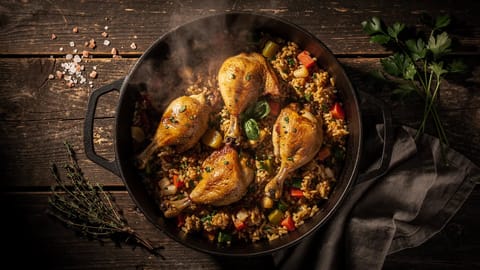
A practical guide to one pot cooking for beginners. Covers equipment, essential techniques like browning and layering, common mistakes, and 12 easy recipes organized by category: pasta, soups and stews, rice dishes, and curries. Each recipe includes difficulty level, cook time, and cost per serving.
Dutch Oven
A heavy, thick-walled cooking pot with a tight-fitting lid — essential for braising, baking bread, and slow cooking.
Braising
A slow-cooking method that sears food at high heat, then simmers it in liquid in a covered pot until tender.
Roasting
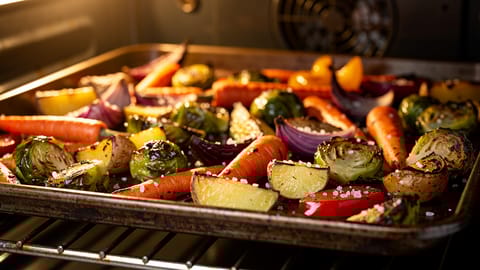
Dry-heat oven cooking method that caramelizes the exterior while keeping the interior moist and tender.