 Bastien
Carryover Cooking
The phenomenon where food continues to cook after being removed from heat, as residual thermal energy from the exterior migrates to the cooler interior.
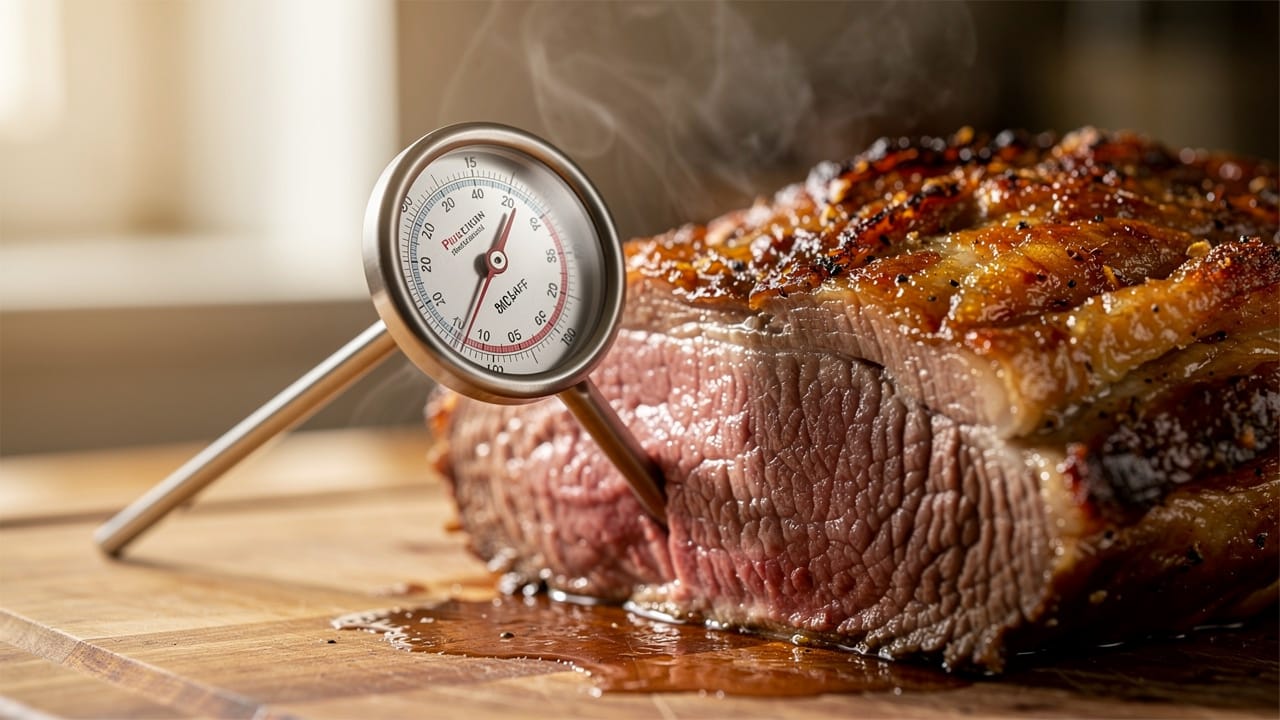
Carryover cooking is the phenomenon where food continues to cook after being removed from heat. The outer layers of a hot piece of meat are significantly hotter than the center, and that stored thermal energy keeps flowing inward, raising the internal temperature even while the food sits on a cutting board. Understanding carryover is the difference between perfectly cooked and overcooked protein — and the reason you should always pull meat before it reaches your target temperature.
How carryover cooking works
Heat always flows from hot to cold. During cooking, the exterior of meat reaches temperatures far above the interior. When you remove the food from heat:
- The exterior is much hotter than the center (often 90°C+ outside vs. 50°C inside for a steak)
- Heat continues migrating inward toward the cooler center
- The internal temperature rises while the surface temperature drops
- Both converge toward an equilibrium temperature
This process takes 5-20 minutes depending on the size of the cut. The temperature rise happens regardless of whether you rest the meat — but resting also allows juices to redistribute, so both effects work together.
Temperature rise by protein and size
Use an instant-read thermometer to verify these numbers with your specific cut and cooking method.
| Protein | Cut / size | Cooking method | Expected carryover |
|---|---|---|---|
| Beef steak | 2.5 cm (1") | Searing / grill | 3-5°C (5-10°F) |
| Beef steak | 5 cm (2") | Searing / grill | 5-8°C (10-15°F) |
| Prime rib / rib roast | 2-4 kg | Oven roast | 5-8°C (10-15°F) |
| Beef tenderloin | Whole, 1.5-2 kg | Oven roast | 5-8°C (10-15°F) |
| Pork loin roast | 1-2 kg | Oven roast | 5-8°C (10-15°F) |
| Pork tenderloin | 400-600g | Oven / sear | 3-5°C (5-10°F) |
| Pork chop | 2.5 cm (1") | Pan / grill | 3-5°C (5-10°F) |
| Whole chicken | 1.5-2 kg | Oven roast | 3-5°C (5-10°F) |
| Turkey | 5-8 kg | Oven roast | 5-8°C (10-15°F) |
| Chicken breast | Boneless | Pan / oven | 2-3°C (3-5°F) |
| Lamb leg | 2-3 kg | Oven roast | 5-8°C (10-15°F) |
| Bread loaf | Standard | Oven | 5-10°C (10-20°F) |
The pattern
- Thicker and heavier = more stored heat = more carryover
- Thinner and lighter = less stored heat = minimal carryover
- Higher cooking temperature = bigger temperature gradient = more carryover
- Lower cooking temperature = smaller gradient = less carryover
Pull temperatures: when to remove from heat
Account for carryover by pulling meat early. These pull temperatures assume resting for the appropriate time.
Beef
| Target doneness | Final temp | Pull temp (thick roast) | Pull temp (steak) |
|---|---|---|---|
| Rare | 49°C (120°F) | 41-43°C (106-110°F) | 44°C (112°F) |
| Medium-rare | 54°C (130°F) | 46-49°C (115-120°F) | 49°C (120°F) |
| Medium | 60°C (140°F) | 52-54°C (126-130°F) | 55°C (131°F) |
| Medium-well | 66°C (150°F) | 57-60°C (135-140°F) | 60°C (140°F) |
Poultry
| Target | Pull temp (whole bird) | Pull temp (breast) |
|---|---|---|
| 74°C (165°F) — FDA minimum | 68-71°C (155-160°F) | 71°C (160°F) |
| 74°C via time at temp | 63-66°C (145-150°F) | 66°C (150°F) |
Poultry is safe at lower temperatures if held long enough — 63°C (145°F) for 8.4 minutes achieves the same pathogen reduction as 74°C (165°F) instantly. Carryover and resting time contribute to this hold time.
Pork
| Target | Pull temp (roast) | Pull temp (chop) |
|---|---|---|
| 63°C (145°F) | 57-60°C (135-140°F) | 60°C (140°F) |
| 71°C (160°F) — ground pork | 66°C (150°F) | 66°C (150°F) |
Factors that increase or decrease carryover
| Factor | More carryover | Less carryover |
|---|---|---|
| Mass | Large roasts | Thin cutlets |
| Cooking temp | High-heat searing, 260°C+ oven | Low-temp oven, sous vide |
| Temperature gradient | Large (hot outside, cool inside) | Small (even throughout) |
| Resting method | Tented with foil, wrapped | Uncovered on a wire rack |
| Bone-in vs boneless | Bone-in (bone retains heat) | Boneless |
| Fat cap | Thick fat cap (insulates) | Trimmed |
Why sous vide has almost no carryover
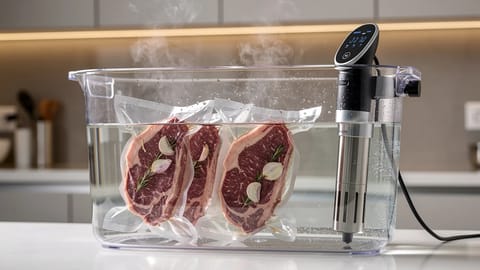
Sous vide cooking holds food at a precise target temperature for an extended period. The interior and exterior reach the same temperature, eliminating the gradient that drives carryover. When you pull a steak from a 54°C sous vide bath, there is no hotter exterior to push heat inward. If you sear after sous vide, you create a brief, thin hot zone — expect only 1-2°C of carryover.
The science of heat transfer in meat
Meat conducts heat relatively slowly compared to metals. During cooking at high temperatures, a steep thermal gradient forms: the surface may be 200°C+ while the center is still 40°C. This gradient is the engine of carryover cooking.
The energy stored in the hot outer layers is substantial. Even after you remove the heat source, that energy has nowhere to go but inward. The center temperature continues rising until the gradient flattens — typically 5-15 minutes after removal.
This is the same physics behind resting meat. As the temperature equalizes, the muscle fibers relax and reabsorb some of the juices that were squeezed toward the center during cooking. Cutting too early means both an undercooked center (carryover not complete) and juice loss (fibers still contracted).
Carryover in baking
Carryover applies to baked goods too. Bread continues baking internally after leaving the oven — the center can rise 5-10°C. This is why bread bakers check internal temperature (target: 93-99°C / 200-210°F for most breads) and why cooling on a wire rack matters. Cookies also firm up during cooling due to carryover — pull them when they look slightly underdone.
Common mistakes
| Mistake | Why it happens | Fix |
|---|---|---|
| Cooking to exact target temp | Not accounting for carryover | Pull 3-8°C (5-15°F) early depending on size |
| Ignoring cut thickness | Assuming all meat carries over equally | Thick cuts carry over more; thin cuts almost none |
| Slicing immediately | Impatience | Rest for at least 5-10 min (steaks) or 15-30 min (roasts) |
| Checking temp only once | Temperature changes during rest | Check at pull and again after resting |
| Tenting too tightly | Traps steam, softens crust | Tent loosely or rest uncovered for crispy exterior |
| Not using a thermometer | Guessing doneness by time or touch | Use an instant-read thermometer every time |
Tips
- Always use an instant-read thermometer — it is the only reliable way to account for carryover
- For reverse-seared steaks (low oven then high-heat sear), expect less carryover because the gradient is smaller
- Keep a log of your pull temps and final temps for cuts you cook often — you will dial in your preferences quickly
- Braised meats have minimal carryover because they cook in liquid at relatively low temperatures with even heat distribution
- When in doubt, pull early — you can always return meat to heat, but you cannot uncook it
Carryover cooking in Fond
Fond's cook mode displays target temperatures for each protein and suggests pull temperatures that account for carryover. Timers include resting periods so you know when to slice. All temperatures are adjusted based on the cut and cooking method you select.
Frequently asked questions
How do I know exactly how much carryover to expect?
It depends on size, cooking temperature, and resting conditions. Start with the tables above, then refine by tracking your results. After cooking the same cut 2-3 times with a thermometer, you will know your specific carryover within 1-2°C.
Does carryover cooking make meat safe to eat?
Carryover contributes to food safety because it adds to the time spent at elevated temperatures. Pasteurization depends on both temperature and time — holding meat at 63°C for several minutes kills the same pathogens as reaching 74°C instantly. However, do not rely solely on carryover for safety with poultry or ground meat.
Should I rest meat covered or uncovered?
For crispy-skinned poultry or seared steaks, rest uncovered or loosely tented — tight wrapping steams the exterior and softens the crust. For large roasts where crust is less critical, tenting with foil helps retain warmth during a longer rest.
Does carryover happen with vegetables?
Minimally. Vegetables have higher water content and lower density than meat, so they cool faster. There is some carryover in large, dense vegetables like whole beets or potatoes, but it is rarely significant enough to affect cooking decisions.
What about fish?
Fish has minimal carryover — usually 1-2°C at most. Fish is thin, cooks quickly, and has a different protein structure. Pull fish when it is barely underdone at the center; it will finish in a minute or two.
Cook smarter
Join the waitlist for Fond. Recipes, meal plans, and a little AI sous-chef that learns how you cook.
Related terms
Braising
A slow-cooking method that sears food at high heat, then simmers it in liquid in a covered pot until tender.
Instant-Read Thermometer
A kitchen thermometer that gives accurate temperature readings in seconds — the most reliable way to check doneness.
Maillard Reaction
The chemical reaction between amino acids and sugars that occurs when food is heated, creating the brown color and complex flavors of seared meat, toasted bread, and roasted coffee.
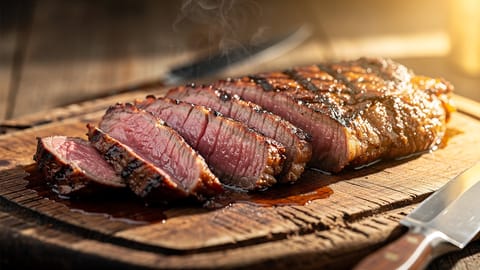
Resting Meat
Letting cooked meat sit before cutting — allows juices to redistribute, resulting in a more flavorful and moist result.
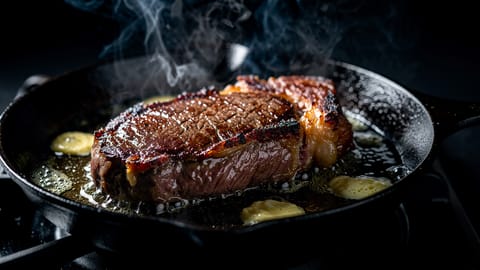
Searing
High-heat browning technique that creates a flavorful Maillard crust on meat, fish, or vegetables.
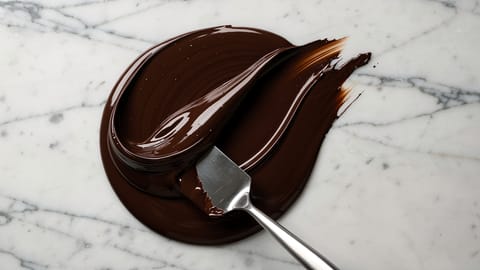
Tempering
Gradually adjusting the temperature of a sensitive ingredient to prevent curdling (eggs) or seizing (chocolate).
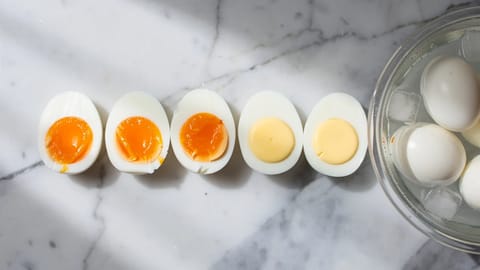
How long to boil eggs for soft, medium, and hard yolks
The difference between a runny, jammy, or fully set yolk comes down to minutes. Knowing how long to boil eggs removes the guesswork and gives you the exact result you want, every single time.
Sous vide for beginners: precision cooking without the guesswork
Everything you need to start cooking sous vide at home. Covers equipment, the basic process, a time and temperature chart for common proteins, your first steak cook, finishing techniques, meal prep strategies, common mistakes, and food safety basics.