 Bastien
Instant-Read Thermometer
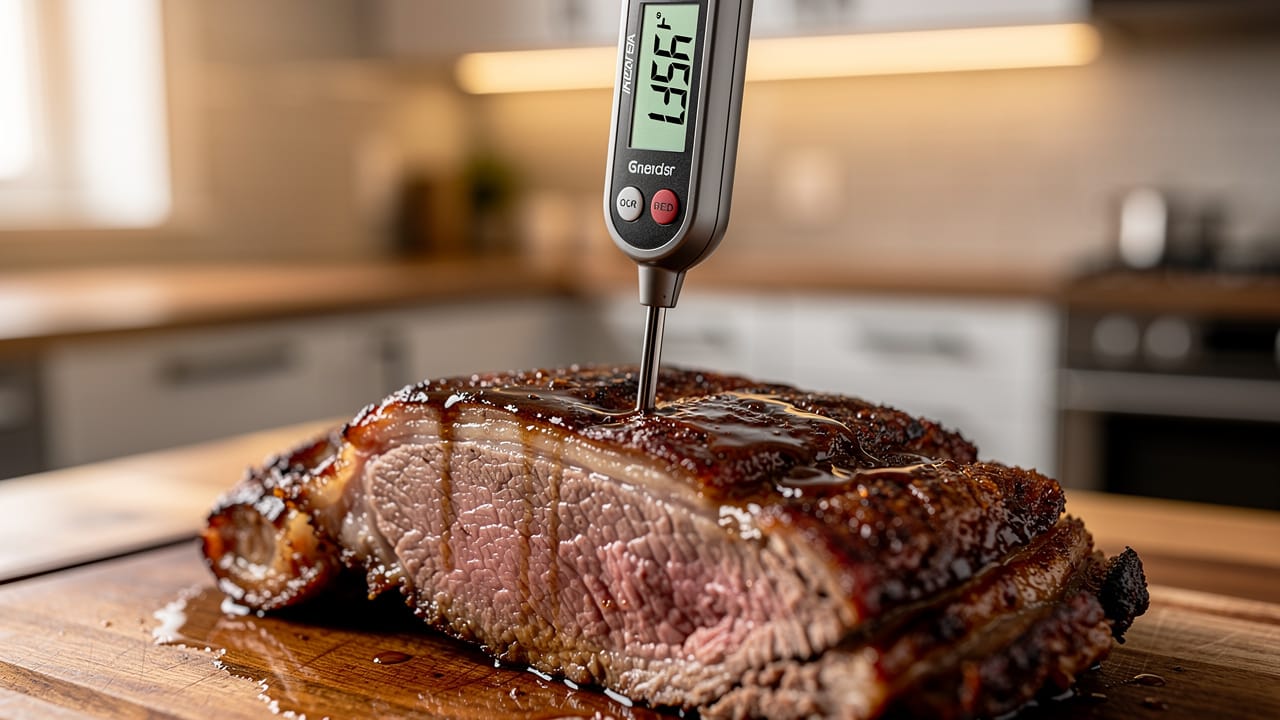
A kitchen thermometer that gives accurate temperature readings in seconds — the most reliable way to check doneness.
An instant-read thermometer is a probe thermometer that displays the internal temperature of food within 2-5 seconds. It is the single most reliable way to determine whether meat is safe to eat, bread is fully baked, or oil is at the right temperature for frying — replacing the guesswork of cutting into food, pressing with your finger, or timing alone.
If you own only one kitchen tool beyond the basics, this should be it. Professional cooks use thermometers constantly, and the technique gap between restaurant food and home cooking often comes down to temperature accuracy. A well-seared steak, a perfectly roasted chicken, and properly poached eggs all depend on hitting precise temperatures.
Target temperatures for meat
These are pull temperatures — the point at which you remove the meat from heat. Carryover cooking will raise the internal temperature by 3-10°F (2-5°C) during resting.
| Protein | Doneness | Pull temp | Final temp (after rest) |
|---|---|---|---|
| Chicken / turkey (breast) | Done | 160°F (71°C) | 165°F (74°C) |
| Chicken / turkey (thigh) | Done | 175°F (79°C) | 180°F (82°C) |
| Beef | Rare | 120°F (49°C) | 125°F (52°C) |
| Beef | Medium-rare | 128°F (53°C) | 133°F (56°C) |
| Beef | Medium | 135°F (57°C) | 140°F (60°C) |
| Beef | Medium-well | 145°F (63°C) | 150°F (66°C) |
| Pork (chops, loin) | Done | 140°F (60°C) | 145°F (63°C) |
| Pork (shoulder, pulled) | Done | 195-205°F (90-96°C) | — |
| Lamb | Medium-rare | 130°F (54°C) | 135°F (57°C) |
| Fish (salmon) | Medium | 120°F (49°C) | 125°F (52°C) |
| Fish (white, flaky) | Done | 130°F (54°C) | 135°F (57°C) |
| Shrimp | Done | 120°F (49°C) | — |
USDA safe minimums require 165°F (74°C) for poultry, 145°F (63°C) for whole cuts of beef/pork/lamb, and 160°F (71°C) for ground meat. The pull temperatures above account for carryover cooking to reach these minimums.
Other key temperatures
| Application | Temperature |
|---|---|
| Bread (lean, fully baked) | 200-210°F (93-99°C) |
| Bread (enriched, fully baked) | 190°F (88°C) |
| Oil for deep frying | 350-375°F (175-190°C) |
| Oil for pan-frying | 325-350°F (165-175°C) |
| Poaching liquid | 160-180°F (70-82°C) |
| Simmering liquid | 185-205°F (85-96°C) |
| Sugar syrup (soft ball) | 235-240°F (113-116°C) |
| Sugar syrup (hard crack) | 300-310°F (149-154°C) |
| Tempered chocolate (dark) | 88-90°F (31-32°C) |
Types of kitchen thermometers
| Type | Speed | Best for | Price range |
|---|---|---|---|
| Digital instant-read | 2-5 sec | Spot-checking meat, bread, oil | $15-100 |
| Leave-in probe | Continuous | Roasting, braising, smoking | $20-80 |
| Infrared (laser) | Instant | Surface temps (pans, grills) | $15-50 |
| Dial (analog) | 15-30 sec | Backup / frying | $5-15 |
| Smart probe (Bluetooth/WiFi) | Continuous | Hands-free monitoring, smoking | $80-200 |
For most home cooks, a single digital instant-read thermometer is all you need. If you do a lot of roasting or braising, add a leave-in probe. Infrared thermometers are useful for checking pan surface temperature before searing.
How to use an instant-read thermometer
Insert into the thickest part. The center of the thickest portion takes the longest to cook and is where you're most likely to find undercooked meat. For a chicken breast, that's the fattest point. For a steak, insert from the side into the geometric center.
Avoid bone. Bone conducts heat differently than meat. If your probe touches bone, the reading will be artificially high. Pull back slightly until the temperature stabilizes.
Check multiple spots. Large roasts, whole chickens, and irregularly shaped cuts may have hot and cold zones. Take readings from several spots and use the lowest as your reference.
Account for carryover cooking. Residual heat continues cooking meat after you remove it from the oven or pan. Pull meat 5-10°F (3-5°C) below your target, then let it rest. Thicker cuts carry over more than thin ones.
Insert from the top for thin cuts. For burgers, thin steaks, and fish fillets, insert the probe from the top straight down rather than from the side, so the sensing tip sits in the thinnest dimension's center.
Calibrate periodically. Fill a glass with ice and cold water, wait 1 minute, then insert the thermometer. It should read 32°F (0°C). Many digital thermometers have a calibration button; for dial types, adjust the nut behind the dial face.
When to check temperature
During searing or pan-cooking: Check toward the end of cooking. Don't pierce meat repeatedly early in cooking — each poke releases juices.
During roasting: Start checking about 75% of the way through the estimated cooking time. Oven temperatures vary and thermometers are the only reliable indicator of doneness.
For poaching: Check liquid temperature before adding food. Check food temperature near the end of cooking.
For bread: Insert into the bottom or side of the loaf. A fully baked lean bread reads 200-210°F (93-99°C). If it reads below 190°F, bake longer regardless of crust color.
For frying oil: Check before adding food. Clip the thermometer to the pot side or use a leave-in probe. Oil temperature drops when food is added, so start slightly above target.
Instant-read thermometer vs other doneness methods
| Method | Reliability | When it works |
|---|---|---|
| Thermometer | Very high | Always — the gold standard |
| Touch/finger test | Low-medium | Only with extensive experience |
| Cutting into meat | Medium | Works but loses juices |
| Timer only | Low | Too many variables (thickness, starting temp, oven accuracy) |
| Jiggle test (roasting) | Low-medium | Only for experienced cooks with specific proteins |
| Color (pork, chicken) | Unreliable | Pink pork can be fully cooked; brown chicken can be undercooked |
Never rely on meat color alone. Pork at 145°F (63°C) is often pink — and perfectly safe. Chicken can appear done while still undercooked at the bone. A thermometer removes all ambiguity.
Instant-read thermometer in Fond
Fond's Cook Mode prompts you to check temperature at the right moments during cooking. When a recipe includes a target temperature, Fond displays it prominently and reminds you to account for carryover cooking. For proteins that need resting, Fond starts a rest timer automatically when you confirm the target temperature is reached.
Frequently asked questions
What's the best instant-read thermometer?
Look for: reads in under 3 seconds, accurate to ±1°F (±0.5°C), thin probe tip (for thin cuts), backlit display, and water resistance. Thermoworks, ThermoWorks, and Lavatools make consistently well-reviewed models at various price points.
Can I leave an instant-read thermometer in the oven?
No. Instant-read thermometers are designed for spot-checking, not continuous exposure to oven heat. For oven monitoring, use a leave-in probe thermometer rated for oven temperatures.
How accurate are cheap thermometers?
Budget thermometers ($10-15) can be surprisingly accurate — within ±2°F (±1°C) — but they're often slow (10+ seconds) and less durable. For occasional use, they work. For regular cooking, invest in a faster model.
Do I need a thermometer for vegetables?
Not usually. Vegetables are done when they reach your preferred texture. The exceptions: baked potatoes (210°F / 99°C for fluffy interior) and deep-fried items where oil temperature matters.
Cook smarter
Join the waitlist for Fond. Recipes, meal plans, and a little AI sous-chef that learns how you cook.
Related terms
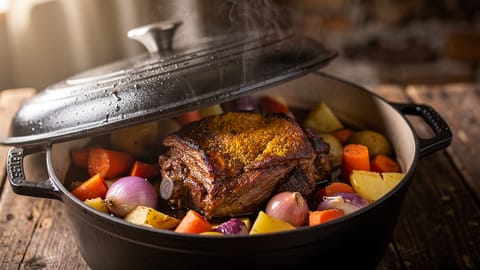
Braising
A slow-cooking method that sears food at high heat, then simmers it in liquid in a covered pot until tender.
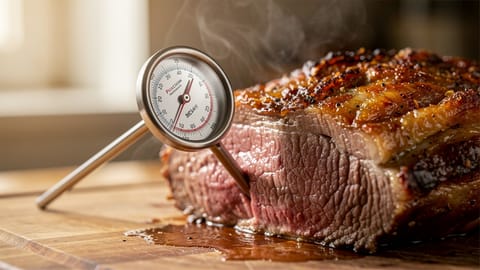
Carryover Cooking
The phenomenon where food continues to cook after being removed from heat, as residual thermal energy from the exterior migrates to the cooler interior.
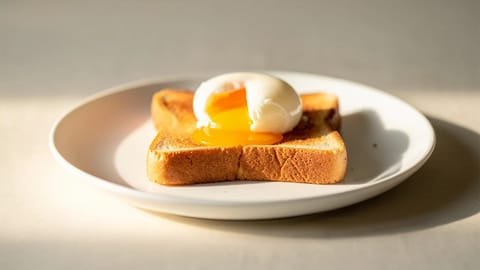
Poaching
Gentle cooking technique using liquid at low temperatures (160-180°F) to preserve the delicate texture of eggs, fish, and poultry.
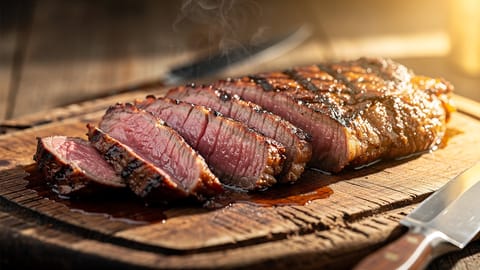
Resting Meat
Letting cooked meat sit before cutting — allows juices to redistribute, resulting in a more flavorful and moist result.
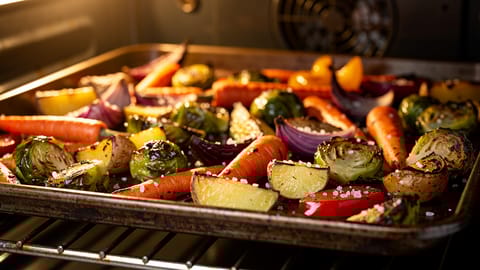
Roasting
Dry-heat oven cooking method that caramelizes the exterior while keeping the interior moist and tender.
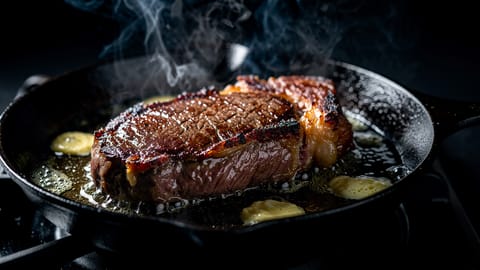
Searing
High-heat browning technique that creates a flavorful Maillard crust on meat, fish, or vegetables.