 Bastien
Maillard Reaction
The chemical reaction between amino acids and sugars that occurs when food is heated, creating the brown color and complex flavors of seared meat, toasted bread, and roasted coffee.
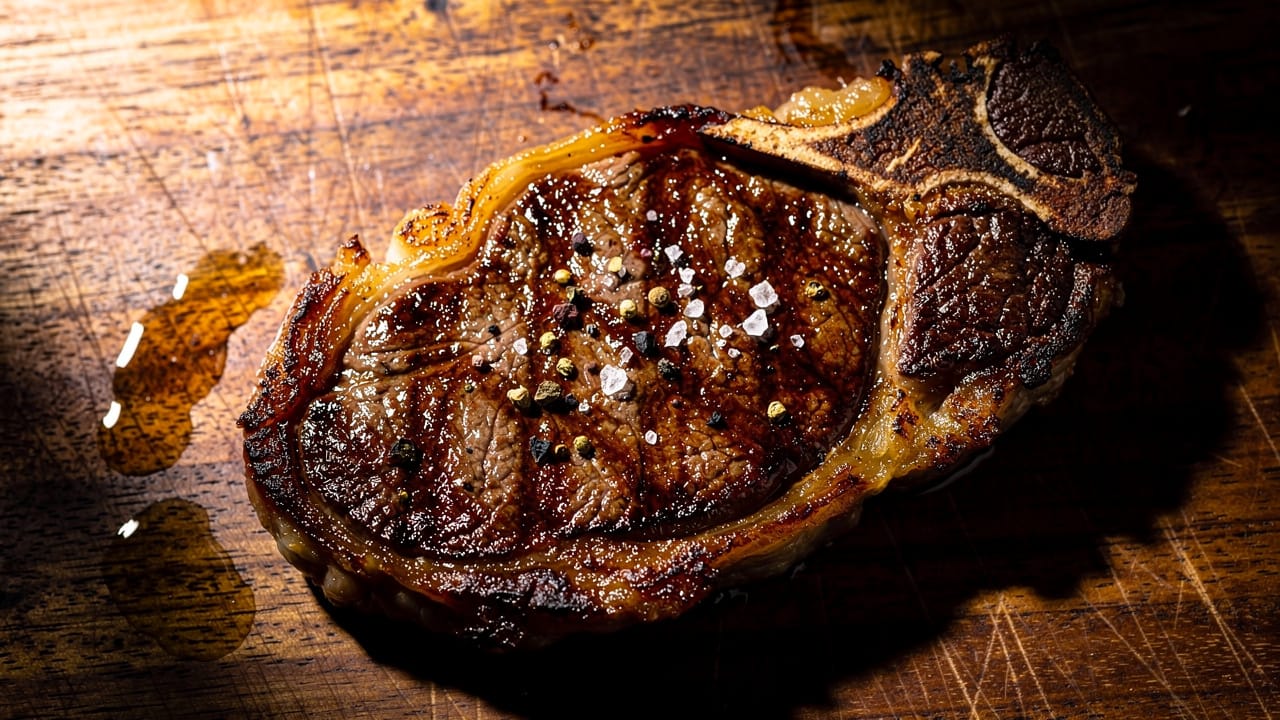
The Maillard reaction is the chemical reaction between amino acids and reducing sugars that occurs when food is heated above 140°C (280°F). It produces the brown crust on a seared steak, the golden color of baked bread, the roasted notes in coffee, and hundreds of other flavor and aroma compounds that make cooked food taste the way it does.
Named after French chemist Louis-Camille Maillard, who first described the reaction in 1912, it is arguably the single most important chemical reaction in cooking. Understanding how it works gives you direct control over flavor, color, and texture.
How the Maillard reaction works
The reaction begins when amino acids (from proteins) and reducing sugars (glucose, fructose, lactose) are heated together above approximately 140°C (280°F). It proceeds through three stages:
- Initial stage. An amino acid and a sugar molecule combine to form an unstable compound called a glycosylamine, which rearranges into an Amadori product.
- Intermediate stage. The Amadori products break down through multiple pathways, producing a cascade of reactive molecules — furanones, reductones, and dicarbonyl compounds.
- Final stage. These intermediates polymerize into melanoidins (the brown pigments you see) and hundreds of volatile flavor and aroma compounds.
Each food produces a different set of compounds depending on which amino acids and sugars are present, which is why seared beef, toasted bread, and roasted coffee all smell and taste completely different despite all being products of the same reaction.
Factors that affect the Maillard reaction
Temperature
| Range | Effect | Examples |
|---|---|---|
| Below 140°C (280°F) | Reaction is very slow or does not occur | Boiling, poaching, steaming |
| 140-180°C (280-355°F) | Optimal browning and flavor development | Searing, roasting, baking |
| Above 200°C (400°F) | Burning begins, bitter and acrid compounds form | Charring, blackening |
This is why food boiled in water (max 100°C) never browns — the temperature cannot reach the Maillard threshold. It is also why a good sear requires a ripping-hot pan.
Moisture
Water is the enemy of browning. Wet surfaces cannot exceed 100°C because the energy goes into evaporating water rather than heating the food. This has practical consequences:
- Pat meat dry with paper towels before searing. This is the single most effective step you can take.
- Do not overcrowd the pan. Too much food releases moisture faster than it can evaporate, dropping the pan temperature and steaming instead of browning.
- Use high heat to evaporate surface moisture quickly so the Maillard reaction can begin.
- Salt early. Kosher salt draws moisture to the surface. If you salt 40+ minutes ahead, the moisture is reabsorbed and the surface dries — producing better browning.
pH level
Alkaline (higher pH) environments speed the Maillard reaction. Acidic environments slow it.
- Pretzels are dipped in a lye (sodium hydroxide) solution before baking, which is why they brown so deeply.
- Baking soda trick. A pinch of baking soda added to onions raises the pH and speeds browning dramatically — caramelized onions in 15 minutes instead of 45.
- Acidic marinades (vinegar, citrus) slow browning. Pat the surface dry and remove excess marinade before searing.
Protein and sugar content
More amino acids plus more reducing sugars equals a stronger Maillard reaction.
- Milk powder added to bread dough or cookie batter contributes both lactose (sugar) and milk proteins, intensifying browning and flavor.
- A thin coating of sugar in dry rubs helps meat brown faster — but sugar burns above 180°C, so monitor closely.
- Aged meat browns more readily because enzymatic breakdown has freed more amino acids.
Maillard reaction vs caramelization
These two browning reactions are often confused. They are different processes that frequently occur at the same time.
| Property | Maillard reaction | Caramelization |
|---|---|---|
| Reactants | Amino acids + reducing sugars | Sugars only (no protein needed) |
| Temperature onset | 140°C (280°F) | 160°C (320°F) |
| Flavor profile | Savory, complex, meaty, bready | Sweet, nutty, butterscotch, bitter |
| Color | Golden to dark brown | Light amber to dark brown |
| Common in | Seared meat, bread crust, coffee | Crème brûlée, caramel sauce, roasted onions |
| Requires protein? | Yes | No |
In most cooking scenarios, both reactions happen simultaneously. When you roast vegetables, the Maillard reaction acts on the amino acids while caramelization acts on the sugars. The combination produces more complex flavor than either reaction alone.
Maximizing the Maillard reaction in cooking
Searing meat
A great sear depends entirely on maximizing contact between dry, high-protein surfaces and a very hot pan.
- Remove meat from the refrigerator 30 minutes before cooking.
- Pat the surface completely dry with paper towels.
- Season with kosher salt — ideally 40+ minutes ahead.
- Heat a cast iron skillet or heavy pan until smoking.
- Add a high-smoke-point oil, then place the meat. Do not move it for 3-4 minutes.
- Flip once. The crust should release naturally when ready.
- Deglaze the pan afterward to capture the browned fond — concentrated Maillard flavor — into a pan sauce.
Roasting vegetables
- Cut for maximum surface area — halves and flat sides down, not small cubes.
- Toss with oil and spread in a single layer on a sheet pan. Do not pile or overlap.
- Roast at 200°C+ (400°F+). Convection mode helps by removing steam.
- Do not stir for the first 15-20 minutes — let the contact side brown undisturbed.
Baking bread
- Start with a high oven temperature (230°C / 450°F) to drive rapid surface browning.
- Add steam in the first 10 minutes — it gelatinizes surface starches, which then brown better when the steam is removed.
- Reduce temperature and bake dry for the remainder. An egg wash or milk wash adds extra proteins and sugars for deeper color.
Browning in braised dishes
The initial sear before braising is where all the Maillard flavor enters a braise. Sear meat aggressively before adding liquid, then deglaze to capture every bit of fond. Without this step, braised dishes taste flat.
The Maillard reaction in everyday cooking
| Food | Maillard signature | Key contributing factors |
|---|---|---|
| Seared steak | Dark brown crust, beefy aroma | High protein, hot pan, dry surface |
| Toasted bread | Golden color, nutty flavor | Starch-derived sugars, dry heat |
| Roasted coffee | Complex bitterness, caramel notes | Free amino acids, high temperature |
| French fries | Crispy golden exterior | Surface starch sugars, high oil temp |
| Grilled onions | Sweet-savory depth | Natural sugars + amino acids |
| Roasted chicken skin | Crispy, deeply flavored | Protein-rich skin, oven heat |
| Cookies | Brown edges, butter-toffee flavor | Butter proteins, brown sugar |
| Soy sauce | Deep brown color, umami | Months of slow Maillard during fermentation |
The Maillard reaction in Fond
Fond's Cook mode includes temperature guidance for techniques that rely on the Maillard reaction — searing, roasting, and the browning step in braised dishes. Step-by-step instructions remind you to dry surfaces and preheat pans so you get the best possible browning.
Frequently asked questions
Is the Maillard reaction the same as caramelization?
No. The Maillard reaction requires both amino acids (proteins) and sugars. Caramelization involves only sugars. They happen at similar temperatures and often occur together, but they produce different flavor compounds.
Does the Maillard reaction happen when boiling food?
Not meaningfully. Water boils at 100°C, well below the 140°C threshold. This is why boiled meat is gray and bland while seared meat is brown and flavorful.
Is browning the same as burning?
No. Browning (Maillard reaction) produces hundreds of desirable flavor compounds. Burning (pyrolysis) breaks molecules down into carbon and produces bitter, acrid tastes. The line between them is temperature and time — stay below 200°C and monitor closely.
Why does my food not brown when I follow the recipe?
Three common causes: the surface is too wet (pat dry), the pan is not hot enough (preheat longer), or the pan is overcrowded (work in batches). All three relate to keeping surface temperature above 140°C.
Cook smarter
Join the waitlist for Fond. Recipes, meal plans, and a little AI sous-chef that learns how you cook.
Related terms
Braising
A slow-cooking method that sears food at high heat, then simmers it in liquid in a covered pot until tender.
Cast Iron Skillet
A heavy, durable pan made from molten iron that excels at heat retention and develops a natural non-stick surface over time.
Deglazing
Adding liquid to a hot pan to dissolve the caramelized bits stuck to the bottom, creating a flavorful base for sauces.
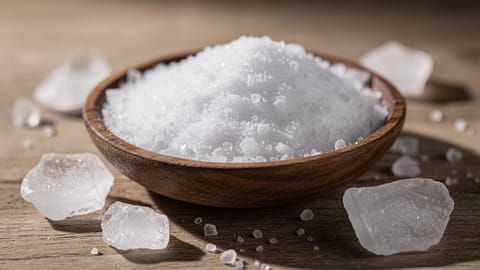
Kosher Salt
A coarse-grained salt with large, flat crystals that's preferred by chefs for seasoning because it's easy to pinch, dissolves well, and has no additives.
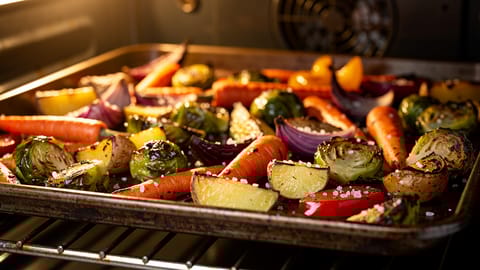
Roasting
Dry-heat oven cooking method that caramelizes the exterior while keeping the interior moist and tender.
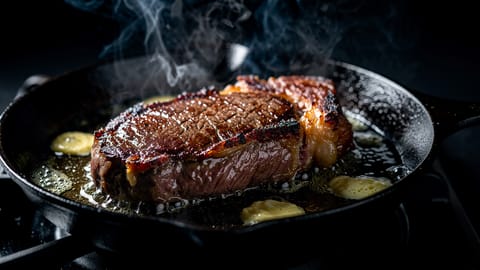
Searing
High-heat browning technique that creates a flavorful Maillard crust on meat, fish, or vegetables.
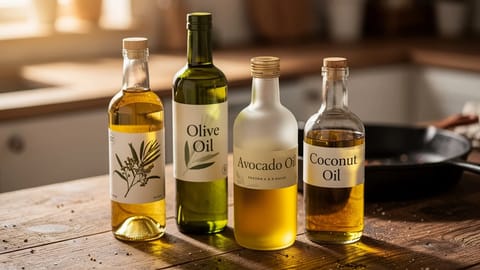
Cooking oil smoke points: the complete guide for every cooking method
Every cooking oil has a temperature limit. Push past it and you get bitter flavors, acrid smoke, and potentially harmful compounds filling your kitchen. That temperature limit is called the smoke point, and knowing it is the difference between a perfect sear and a smoking disaster.
Butter vs oil: when to use each in cooking and baking
Butter and oil each have strengths in the kitchen. Butter brings flavor, browning, and flaky pastry. Oil brings higher heat tolerance, moisture, and a longer shelf life. Knowing when to reach for each — and when to combine them — makes every dish better.
How to make a pan sauce: deglazing 101
A pan sauce turns the browned bits stuck to your skillet into a rich, flavorful sauce in under five minutes. Learn the technique, choose your deglazing liquid, and master pan sauces for chicken, steak, pork chops, and mushrooms.